
So, what exactly is automotive digital marketing? It’s how you promote and sell vehicles online—using everything from search engines and social media to your own dealership website. Think of it as shifting the focus from your physical car lot to all the digital places where modern buyers start their journey. This is absolutely critical for grabbing the attention of today's customers, who do nearly all their research online long before they ever think about stepping onto a lot.
The Modern Showroom Is Digital
For a moment, imagine your dealership’s most valuable real estate isn’t that front row of cars glistening under the sun. Instead, it’s the top spot on a Google search results page. That’s the reality now. The traditional car-buying process, which used to start with a weekend trip to browse different lots, has been completely flipped on its head. Today, that journey begins quietly, usually on a smartphone during a lunch break or a tablet on the couch after dinner.
This fundamental change means your first, and most important, showroom is now a digital one.
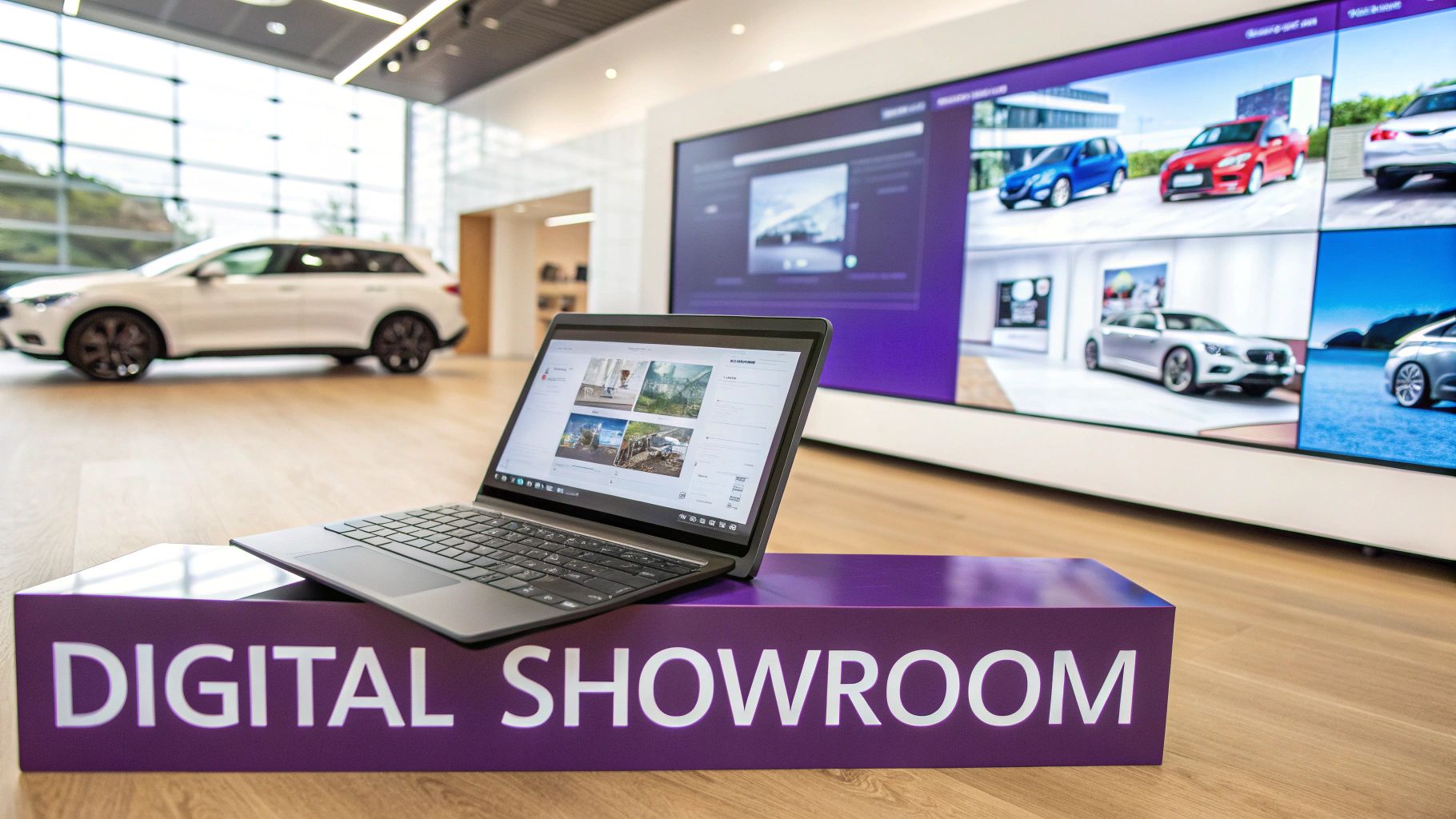
This "digital showroom" isn't just one single place; it's the sum of all your online interactions. It includes your website, your Google Business Profile, customer reviews on sites like Yelp or DealerRater, your social media accounts, and even how your inventory shows up in search results. Each piece works together to shape a buyer's opinion and guide their decisions long before they even consider visiting you in person.
Why Your Digital Presence Comes First
The numbers don't lie. According to recent industry data, a staggering percentage of car shoppers use online resources as their main source of information, completely bypassing the dealership as their first stop. At the same time, many buyers don't know the exact vehicle they want when they start their search. This means a large portion of shoppers are wide open to influence, which is a massive opportunity for dealerships that show up online with the right information at the right time. You can dig into more of these modern car shopping trends from Invoca.
This trend flips the old problem of declining foot traffic into a powerful opportunity. Instead of just waiting for customers to find you, automotive digital marketing lets you go out and meet them where they're already spending their time.
Your digital showroom is your 24/7 salesperson. It's always on, answering questions, showing off your inventory, and building trust, even when your physical lot is closed for the night. It's the engine that drives modern lead generation.
Turning Clicks Into Customers
For an independent used-car dealer, getting this right isn’t just an option—it’s the single most important driver of growth. A strong online presence makes sure you’re visible and credible when a potential buyer in your area searches for "used trucks near me" or a specific make and model you have in stock.
Your digital marketing efforts are really doing three main jobs:
- Building Awareness: Simply making sure local buyers know you exist.
- Demonstrating Credibility: Using professional photos, detailed vehicle descriptions, and positive customer reviews to build trust.
- Capturing Leads: Guiding interested shoppers to call you, send a message, or fill out a finance application on your website.
When it all comes together, a well-executed strategy means that by the time a customer finally steps onto your lot, they're already sold on the idea of doing business with you.
Your Digital Foundation: A High-Performance Website
Think of all your online marketing efforts—your social media posts, your Google ads, your email blasts—as roads. Where do they all lead? Straight to your dealership's website. It's the main building, your digital showroom, open 24/7 and working around the clock to turn clicks into customers.
A cheap, slow, or confusing website is the digital version of a poorly lit lot with messy cars and no one at the front desk. It doesn't matter how great your inventory is; if the online experience is a headache, people will just leave. That's why your website isn't an expense—it's the single most important investment you can make in your digital strategy.
Core Elements of a Website That Sells Cars
A dealership website really only has one job: to turn visitors into leads. To do that well, it has to be built on a few non-negotiable principles. These pieces work together to build trust, answer questions, and make it dead simple for a shopper to take the next step.
Three pillars support every great dealership website:
- Mobile-First Design: Let's face it, nearly everyone starts their car search on a smartphone. Your site has to look and work perfectly on a small screen, with big, easy-to-tap buttons and clear text.
- Lightning-Fast Page Speed: Every extra second a page takes to load is another chance for a potential buyer to give up and go elsewhere. Speed keeps people engaged and is a huge factor in how Google ranks you.
- Intuitive User Experience (UX): A visitor should find what they're looking for—your inventory, phone number, or financing application—in just a few seconds. A clean, logical layout keeps them from getting frustrated and guides them right where you want them to go.
For a deeper dive, our guide on dealership website design breaks these principles down even further with tips for creating an experience that wins over today's car buyers.
From Anonymous Visitor to Qualified Lead
A great-looking site is only half the battle. It also has to be a machine for capturing leads. This is where you transform passive browsing into active, measurable interest.
With online competition getting fiercer by the day, a website that converts well gives you a direct lever on your marketing ROI. The average cost to get a single automotive lead can be significant, according to industry data from platforms like Demand Local. Squeezing more leads out of the traffic you’re already getting is one of the smartest ways to boost your bottom line.
A high-performance website doesn't just display your inventory; it actively persuades visitors to engage. It systematically turns "just looking" into "I'm interested."
To make that happen, your site needs obvious calls-to-action (CTAs). These are clear prompts—like "Test Drive This Car," "Get Pre-Approved," or "Check Availability"—that tell the user exactly what to do next. When you combine strong CTAs with simple lead forms and trust signals like customer reviews, you build the confidence a buyer needs to hand over their contact info.
Driving Traffic with Core Marketing Channels
Once your high-performance website is up and running, it's time to flip the switch and start bringing customers in the door. A great website is a must, but without traffic, it’s basically a digital showroom with the lights off. This is where your marketing channels come in—they’re the roads that bring ready-to-buy local car shoppers right to your inventory.
Think of your marketing strategy like a well-tuned engine. Each channel is a different cylinder, and when they all fire together, they generate the power you need for steady growth. For an independent dealer, the most effective and wallet-friendly cylinders are Search Engine Optimization (SEO), Google Vehicle Listings, Paid Search (PPC), and Social Media Marketing.
Comparing Key Automotive Marketing Channels
To make sense of it all, it helps to see how these channels stack up against each other. Each one plays a different role, and understanding their costs, effort, and timelines will help you decide where to put your focus first.
| Channel | Primary Goal | Typical Cost | Time to Results |
|---|---|---|---|
| Automotive SEO | Build long-term, free organic traffic from search. | Low to Medium (Sweat equity or agency fees) | 3-9 Months |
| Google Vehicle Listings | Showcase specific inventory directly on Google. | Free (Cost for feed management is possible) | 1-2 Weeks |
| Paid Search (PPC) | Drive immediate, high-intent traffic for specific keywords. | Medium to High (Pay-per-click ad spend) | Immediate |
| Social Media | Build community, brand loyalty, and leverage platforms like Marketplace. | Low (Ad spend is optional) | Varies |
This table gives you a bird's-eye view, but remember, the best strategies don't just pick one—they blend them together for maximum impact. A paid ad can bring in a lead today, while your SEO work is quietly building a foundation for free leads tomorrow.
Capture Long-Term Growth with Automotive SEO
Search Engine Optimization, better known as SEO, is all about getting your website to show up organically—meaning for free—on search engines like Google. When a local customer types in "used Honda Civic for sale" or "affordable pickup trucks near me," good SEO is what puts your dealership at the top of that list.
This isn't about quick tricks or loopholes; it's about methodically building a trustworthy online presence. Think of it like earning a solid reputation in your community. You do it by consistently providing value, making sure your site is easy for both people and search engines to navigate, and proving you're a legitimate authority on used cars in your area. The payoff is huge: a steady flow of high-intent traffic that you don't have to pay for with every single click.
A website that's optimized to pull in organic traffic nails three key areas, all of which roll up into a fantastic user experience.
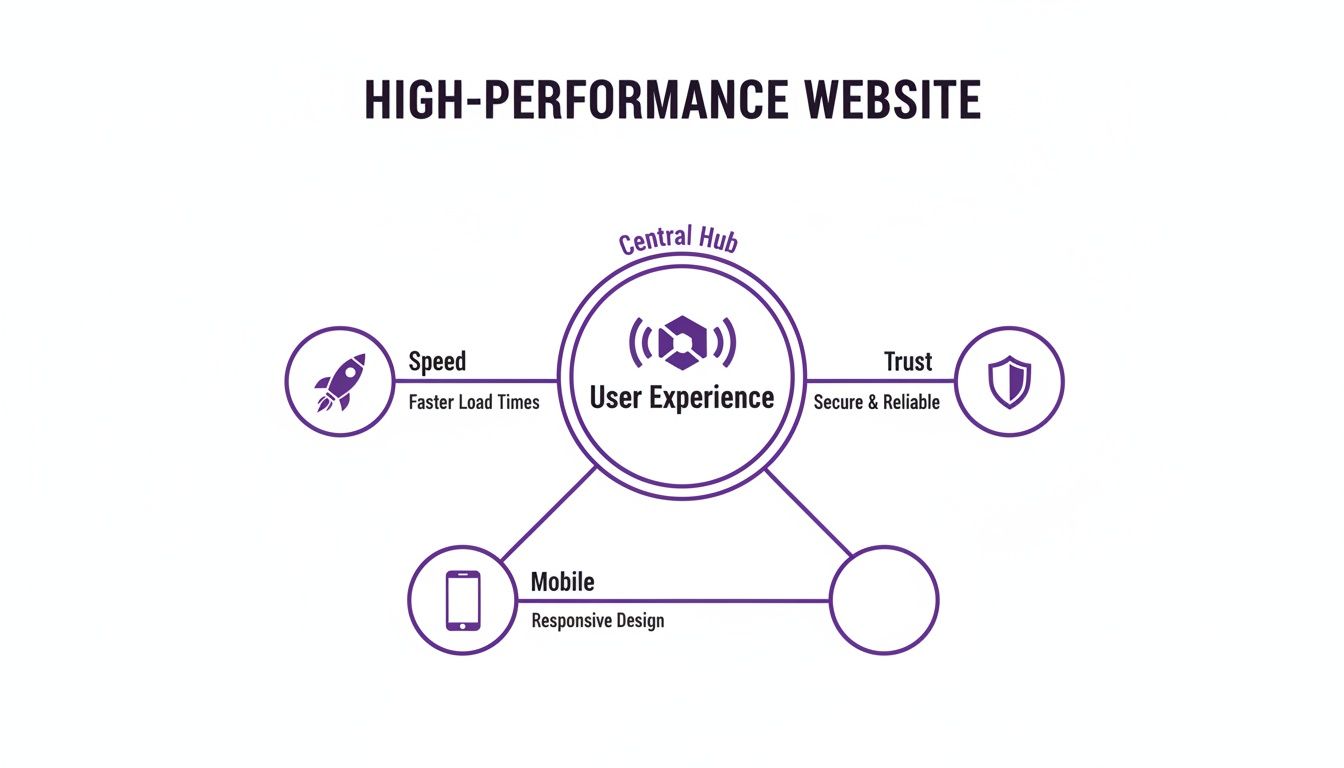
As you can see, a great user experience isn't just one thing. It’s built on the pillars of speed, mobile-friendliness, and trust—and it just so happens these are the exact things that lead to strong SEO performance.
Showcase Your Inventory with Google Vehicle Listings
While SEO is the long game, Google Vehicle Listings (often called Vehicle Ads or VAs) offer a much faster way to get your cars in front of active shoppers. You know what these are—they’re the image-heavy listings that pop up right at the top of Google when someone searches for a specific car. They show a picture, price, mileage, and your dealership's name.
Here's the best part: Google Vehicle Listings are often free. Seriously. By setting up a Google Business Profile and uploading your inventory feed, your vehicles can start appearing in these prime spots without you spending a dime on ads. This is easily one of the most powerful and overlooked tools in automotive digital marketing for independent dealers.
Think of Vehicle Listings as putting your best cars right in the digital front row of the world's biggest car lot—the Google search results page. It’s a direct line to buyers who are done researching and are actively looking to buy.
This channel works so well because it cuts out a step. Shoppers see your actual cars immediately, dramatically shortening the path from their search query to becoming a lead for your dealership.
Target High-Intent Buyers with Paid Search
Paid Search, also known as Pay-Per-Click (PPC), is like renting a digital billboard on the busiest highway in town. Using a platform like Google Ads, you can bid on specific keywords—like "used Ford F-150 in Columbus"—and have your ad appear at the very top of the results, but only for people searching in your area.
You only pay when someone actually clicks on your ad, making it a super-efficient way to target buyers who mean business. Unlike SEO, which can take months to gain traction, a PPC campaign can start driving traffic to your Vehicle Detail Pages (VDPs) within hours of going live.
For an independent dealer, a smart PPC strategy boils down to a few key things:
- Hyper-Local Targeting: Focus your ad budget only on the cities and zip codes you actually serve. This stops you from wasting money on clicks from people who will never visit your lot.
- Specific Keyword Bidding: Go after long-tail keywords (e.g., "2018 Toyota Camry XLE under $20k"). These longer, more detailed searches show a buyer is much closer to making a decision.
- Compelling Ad Copy: Write ads that call out your key selling points. Mention warranties, special financing, or your dealership's great reputation to give people a reason to click your ad over a competitor's.
This laser-focused approach ensures your marketing dollars are spent reaching the people most likely to walk onto your lot.
Build Community with Social Media Marketing
Finally, don't forget about social media. Platforms like Facebook are another powerful way to connect with local buyers. While regular posts are great for building your brand and keeping in touch with past customers, the real game-changer for independent dealers is Facebook Marketplace.
Listing your inventory on Marketplace puts your vehicles smack-dab in front of a massive, local audience that is already in a buying mindset. It functions like a supercharged version of the old classifieds section, giving you a low-cost, high-visibility sales channel.
Beyond Marketplace, just having a consistent social media presence helps you stay top-of-mind. Sharing new arrivals, customer testimonials, and helpful car-buying tips builds a community around your dealership. It reinforces trust and makes your business feel more personal and approachable than a faceless franchise store—and that's how you create a loyal following that brings in both repeat business and referrals.
Winning Your Neighborhood: Local SEO and Reviews
For an independent used-car dealership, the most important customers are often the ones right around the corner. While it's tempting to cast a wide net, your highest-value buyers are usually searching for vehicles just a few miles from home. Winning them over means getting hyper-local with your marketing, combining sharp search visibility with a rock-solid online reputation. This is where your automotive digital marketing strategy gets personal and gives you a real edge over the big guys.
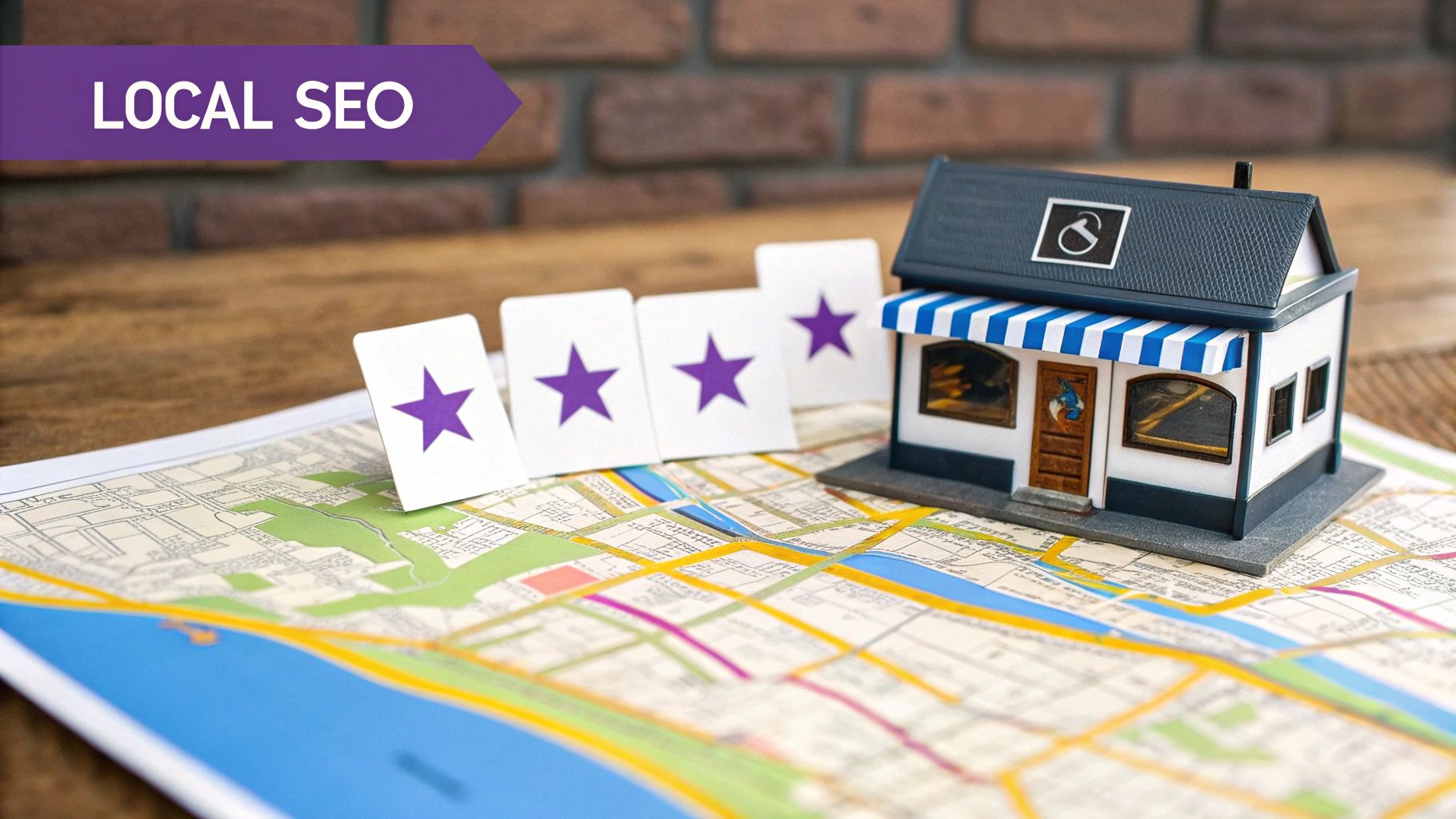
It all starts with your Google Business Profile (GBP). Honestly, this is probably the most powerful local marketing tool you have, and it's free. Think of it as your digital storefront on Google Maps and in those "Local Pack" search results. Keeping it in top shape isn't just a good idea—it's essential for getting local feet on your lot.
Turn Your Google Business Profile Into a Customer Magnet
A half-finished or outdated GBP profile is a huge missed opportunity. To make it work for you, every single section needs to be complete, accurate, and interesting. This tells both Google and your potential customers that you're a professional, active, and trustworthy dealership.
Here's a quick checklist to get your profile humming:
- Consistent and Correct Info: Your dealership name, address, phone number, and hours must be 100% identical everywhere they appear online. No variations.
- Real Photos and Videos: Ditch the generic stock photos. Get high-quality pictures of your lot, your team, and your actual cars. A quick walk-around video of the dealership can build a ton of trust before they even visit.
- Use GBP Posts: Get in the habit of using the "Posts" feature. Announce new arrivals, share a weekend special, or highlight a great customer review. It keeps your profile looking fresh and active.
- Answer Questions Fast: The Q&A section is a public space. When people ask questions, jump on them quickly and professionally. It shows you're responsive and helps other shoppers at the same time.
Your Google Business Profile is your digital handshake with the local community. A well-maintained profile tells customers you're open for business and care about the details, making them far more likely to visit.
For a much deeper dive, check out our complete guide on local SEO for car dealerships. It’s packed with more step-by-step tactics to help you own your local search results.
https://goautofire.com/blog/local-seo-for-car-dealerships
The Make-or-Break Power of Reputation Management
So, a shopper finds you online. What's the very next thing they do? They look for reviews. Your online reputation is the new word-of-mouth, and it can seal the deal—or kill it—before you ever get a chance to talk to someone. A steady flow of positive reviews is social proof that tells new buyers they're making a safe choice with your dealership.
The trick is to make it incredibly easy for your happy customers to leave a review. Don't be shy about asking! A simple follow-up email or text after a sale with a direct link to your Google review page can do wonders.
But reputation management isn't just about chasing five-star ratings. It’s about how you handle all the feedback. Responding to a negative review with professionalism and empathy can be more powerful than a dozen glowing ones. It shows everyone watching that you listen, you care, and you’re committed to making things right. You just can't buy that kind of trust. For more on this, it's worth exploring the automotive industry's specific digital marketing challenges to see how this approach builds a powerful, authentic brand.
Bringing Buyers Back with Lead Nurturing
Getting a phone number or an email from a car shopper isn't the finish line—it's the starting gun. So many potential buyers need a little more time or information before they're ready to pull the trigger, and this is exactly where a lot of dealerships drop the ball. In fact, some studies show that a significant portion of dealer leads aren't followed up with promptly. That's a huge opportunity just left to go cold.
Smart automotive digital marketing is about more than just getting the lead; it’s about nurturing it. Lead nurturing is simply the process of building a relationship with potential customers who've shown interest but aren't quite ready to buy. It's about staying top-of-mind by being helpful, not by hitting them with aggressive sales pitches.
This ongoing conversation keeps your dealership in the running while they do their homework. Before we get into the "how," it helps to understand what lead generation marketing entails to see how these two pieces fit together perfectly.
Keep the Conversation Going with Email Marketing
Email is one of the most powerful and cost-effective tools in your nurturing toolbox. It lets you automate your follow-up and send targeted messages right to a shopper's inbox, keeping your brand and your inventory front and center.
Think of it as a friendly salesperson who checks in once in a while without being pushy. A solid email strategy can make a massive difference in whether a past website visitor comes back to your lot when they're finally ready to sign the papers.
Here are a few simple but incredibly effective email campaigns you can set up:
- New Inventory Alerts: If someone was looking at Ford F-150s on your site, send them an automated heads-up the second a similar truck rolls onto your lot.
- Price Drop Notifications: Immediately let interested buyers know when a car they looked at gets a price cut. It’s a powerful trigger.
- Helpful Content: Send out a quick guide like "5 Things to Check During a Test Drive." This builds trust and shows you're an expert who's there to help, not just sell.
Remind and Re-Engage with Remarketing
Have you ever browsed for a product online, and then suddenly started seeing ads for it on Facebook, news sites, and everywhere else you go? That’s remarketing (sometimes called retargeting), and it’s a game-changer for car dealers. It works by showing your ads only to people who have already visited your website.
This is so effective because you're not shouting into the void. You're talking to a warm audience, reminding them of the exact cars they already expressed interest in. It's the digital version of a customer leaving your lot, and you being able to gently tap them on the shoulder a few days later to say, "Hey, remember that beautiful sedan you loved? It's still here."
If you want to see how this fits into the bigger picture, check out our complete guide on lead generation for car dealerships.
Remarketing keeps your inventory in front of buyers during the most critical part of their journey—the consideration phase. It closes the gap between their first visit and their final decision, dramatically increasing the odds they come back to you.
When you combine consistent email nurturing with strategic remarketing, you build a system that automatically brings interested buyers back to your website and your lot. This approach ensures you get the maximum value out of every single visitor, making your marketing dollars work for you long after that first click.
Your 90-Day Digital Marketing Action Plan
Staring at a long list of marketing tactics can feel like a chore. The secret is knowing you don't have to do it all at once. A solid marketing plan builds momentum, with one step naturally leading to the next.
This 90-day roadmap is designed specifically for independent dealers. It helps you build a strong foundation and get real results without needing a massive budget right out of the gate. Think of it like reconditioning a car for the front line: you start with the deep clean and mechanical check before moving on to the buff and polish. Each stage builds on the last to create a car that sells itself.
Month 1: Laying the Foundation
The first 30 days are all about building your digital storefront. The goal is simple: create a professional, trustworthy online space where people can find you, browse your cars, and easily reach out. If you skip this, any money you spend on ads later is like pouring water into a leaky bucket.
- Week 1-2: Get Your Professional Website Live. This is priority number one. You need a clean, fast website that looks great on a phone. This is your home base. A platform like AutoFire can get you up and running in minutes, and it automatically creates SEO-friendly pages for every car you add to your inventory.
- Week 3-4: Dial In Your Google Business Profile. Claim your free Google Business Profile and fill out everything. Seriously. Upload at least 10 high-quality photos of your dealership, your team, and your best-looking cars. Make sure your name, address, phone number, and hours are perfect, and write a business description that tells people why they should buy from you.
Month 2: Driving The First Wave of Traffic
With your digital foundation solid, it's time to unlock the doors and invite people in. This month is all about turning on the channels that bring local car shoppers to your new website and your vehicle detail pages (VDPs). The key here is to start small, see what works, and then scale up.
This is the part where you connect your actual cars with active, local buyers. The goal isn't just random clicks; it's about getting the right set of eyes on the right inventory.
- Week 5-6: Turn On Your Free Listings. Make absolutely sure your inventory feed is hooked up to your Google Business Profile. This is what allows your cars to show up in the free Google Vehicle Listings. It’s one of the most powerful, zero-cost moves you can make.
- Week 7-8: Launch a Hyper-Local Ad Campaign. You don't need a huge budget. Start with a test of just $10-$15 per day for a Google Ads campaign. Target a tight radius around your lot (say, 10-15 miles) and bid on specific, ready-to-buy keywords like "used Honda CR-V in [Your City]."
Month 3: Optimizing and Following Up
The final 30 days are about sharpening your strategy and making sure no opportunity is missed. You'll have some real data now, which means you can make smarter decisions and start reaching back out to shoppers who showed interest but haven't pulled the trigger yet.
- Week 9-10: Analyze and Adjust. Dive into your website's analytics and your Google Ads dashboard. Which cars are getting the most attention? Which ads are performing best? Do more of what's working and cut what isn't. It's that simple.
- Week 11-12: Start Your Nurture Campaigns. Set up a basic automated email that goes out to new leads, thanking them for their interest and offering to answer questions. At the same time, launch a simple remarketing campaign on Google or Facebook to show ads for the specific cars people already viewed on your site.
A Few Final Questions
Even with a solid plan, a few questions always pop up. Let's tackle some of the most common ones we hear from dealers so you can move forward with confidence.
What’s a Realistic Marketing Budget for a Small Dealership?
This is the big one, right? A common rule of thumb you'll hear is to allocate a percentage of your gross revenue, but honestly, that's not the best way to start when you're independent. You don't need a massive budget to get results.
Start lean and prove what works. Your first dollars should go into the absolute must-haves: a professional website platform and a locked-in Google Business Profile. These are your foundational, low-cost power tools. From there, think small and targeted. Set aside $300-$500 a month for a local Google Ads campaign and watch it like a hawk. The goal isn't just to spend money; it's to figure out your cost per lead and double down on what's actually bringing you buyers.
With All the Data Available, What Metrics Actually Matter?
It's incredibly easy to get buried in data and lose sight of what's important. For an independent dealer, you can cut through the noise by focusing on just three core numbers. These three tell you 90% of the story.
- Website Traffic: Are more people walking through your digital front door this month than last month?
- Leads Generated: How many real people are reaching out via phone calls, contact forms, or text messages?
- Cost Per Lead: This is the ultimate bottom line. Divide your total ad spend by your total leads. Is that number profitable?
Keeping your eyes on these three metrics keeps your marketing honest. They show you in black and white what’s working and what’s a waste of money, letting you make smart decisions without needing a data science degree.
Can I Handle This Myself, or Do I Need to Hire an Agency?
You can absolutely get the ball rolling on your own. In fact, you should. The essential groundwork for your automotive digital marketing is more straightforward than ever, thanks to modern tools.
The secret is to lean on a platform that does the heavy lifting for you. This frees you up to focus on what you do best—sourcing great cars, taking killer photos, and building relationships with customers.
A purpose-built dealership website platform will handle the SEO basics automatically. Managing your Google Business Profile and posting inventory to Facebook Marketplace are things you can definitely do yourself. Down the road, as you grow, maybe you bring in a specialist to manage your paid ads. But the most important first steps? They’re completely in your control.
Ready to lay that digital foundation? With AutoFire, you can get a professional, mobile-first dealership website live in minutes and start turning online shoppers into real leads. Get your inventory online, make it look incredible, and connect with more local buyers—no coding or long-term contracts required. Get started for free on goautofire.com.