 ™
™

Think of automotive SEO as a specialized marketing playbook designed to put your dealership front and center when customers search for cars online. It’s all about making sure your website, and more importantly, your inventory, shows up high in Google Search, on Google Maps, and in those all-important Google Vehicle Listings.
The whole point is to connect you with local buyers at the exact moment they’re ready to pull the trigger on a purchase.
Why Your Dealership Can No Longer Ignore SEO
The game has changed. The way people find and choose a dealership today is completely different than it was even a few years ago. Your website isn't just a digital business card anymore; it's your primary showroom, open 24/7 to a huge audience of local car shoppers. If you don't have a strong online presence, you're basically invisible to most of the customers in your own town.
Traditional marketing—like print ads or radio spots—is like casting a wide, expensive net and just hoping you catch something. You’re paying to interrupt people who probably aren’t even in the market for a car, which is why the results are so unpredictable and often disappointing.
The Modern Car Buyer's Journey
Today, the hunt for a new vehicle almost always starts on a phone or a laptop. Someone types "used trucks in [Your City]" or "Ford dealership near me" into Google, and bam—they have a list of options in seconds. If your dealership isn't on that first page, you don't even get a shot at earning their business.
Think of automotive SEO services like a powerful magnet. Instead of shouting your message out to everyone, you pull in local buyers who are actively raising their hands, searching for the exact cars sitting on your lot.
This shift means your digital strategy isn't just another item on the to-do list; it's the foundation of a modern, sustainable dealership. It’s about being the most helpful and obvious answer when a local buyer asks Google for help.
To really see the difference, let’s compare the old way with the new way.
Old-School Ads vs Modern Automotive SEO
This table breaks down why a solid automotive SEO strategy delivers a much better return on investment for car dealers today.
| Attribute | Traditional Marketing (Print, Radio) | Automotive SEO Services |
|---|---|---|
| Audience Targeting | Broad, untargeted (interrupts everyone) | Highly targeted (reaches active car shoppers) |
| Timing | Tries to create demand | Captures existing, high-intent demand |
| Cost | High upfront cost, pay-to-play | Investment in a long-term asset |
| ROI Measurement | Difficult to track direct results | Directly measurable (traffic, leads, calls) |
| Longevity | Results stop when you stop paying | Builds lasting online authority and traffic |
| Buyer Stage | Reaches people not actively looking | Connects with buyers in the research & purchase phase |
In short, while traditional ads are about broadcasting a message, SEO is about being discovered by people who are already looking for you.
Turning Clicks Into Customers
A smart SEO strategy doesn't just bring you website visitors; it brings you the right visitors. By fine-tuning your online presence, you position your dealership to meet very specific customer needs, which leads to real-world results.
This targeted approach delivers some massive benefits:
- Be Seen Everywhere That Matters: Show up in Google Search, Google Maps, and Google Vehicle Listings—exactly where active buyers are looking.
- Get Higher Quality Leads: You'll connect with shoppers who are serious about buying, not just browsing.
- Build a Real Asset: Create a reliable stream of organic traffic that doesn't vanish the second you turn off your ad budget.
Ultimately, effective automotive SEO is the engine that turns online searches into showroom visits, phone calls, and test drives. It delivers a measurable return on your investment and fuels your dealership’s long-term growth.
The Engine Behind a Winning SEO Strategy
A powerful automotive SEO strategy is a lot like a high-performance engine. It's not one single part that gets you across the finish line, but a whole system of critical components working together perfectly. Each piece has a very specific job, and when they all fire in sync, your dealership pulls ahead of the competition and grabs the attention of local car buyers.
This is what separates a dealership that just exists online from one that's a true lead-generating machine. Think of your website as the car itself. A solid SEO service is the engine that actually makes it go. Without it, you’re just sitting on the lot, waiting for someone to wander by.
The diagram below shows you exactly where a dedicated SEO strategy fits into your marketing plan. It’s not just another ad; it's a magnet for customers who are actively looking for what you sell.
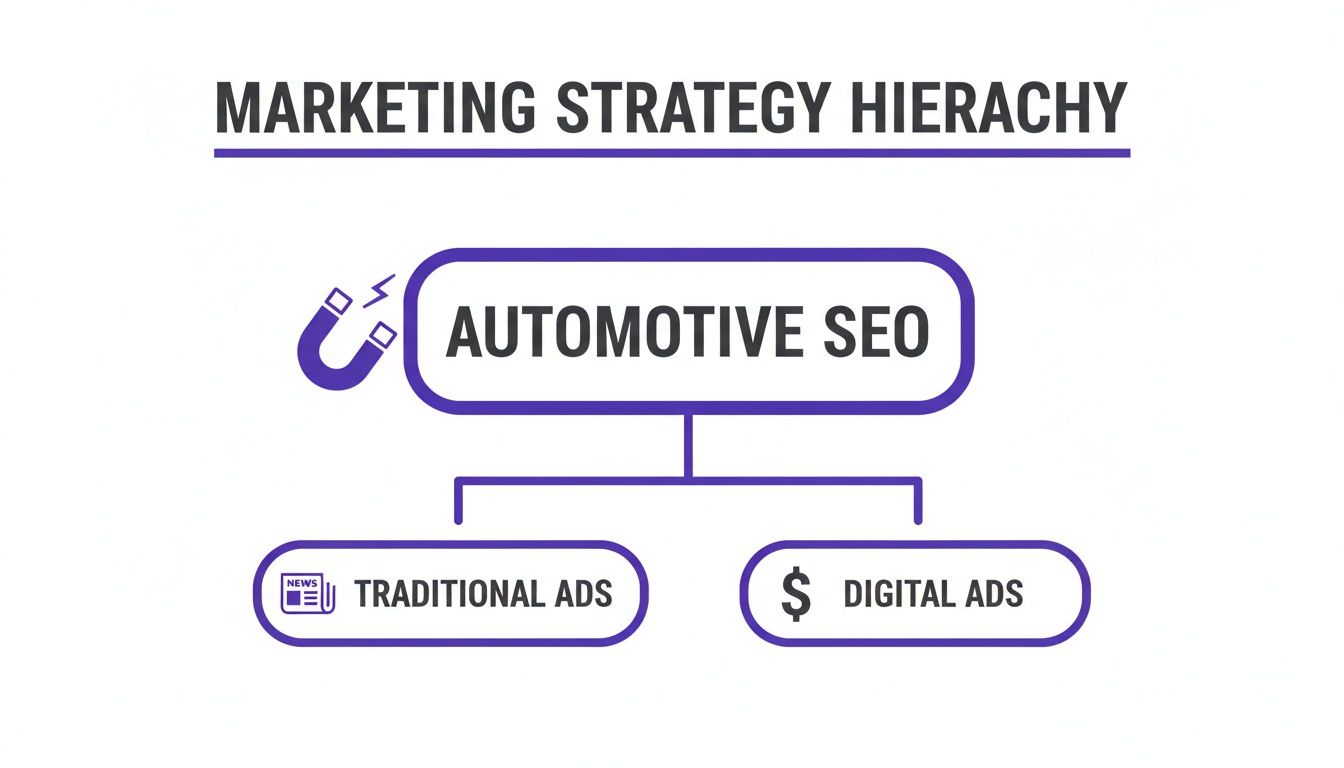
As you can see, SEO is designed to attract motivated buyers, making it a much more efficient use of your marketing budget than traditional ads or even paid digital ads alone.
The Four Core Components
So, what makes this engine run? Let's pop the hood and look at the four main systems. Each one is absolutely essential for getting your dealership to the top of Google and turning those clicks into showroom visits.
Technical SEO (The Engine Block): This is your foundation. Honestly, if your site is slow, has broken links, or is just plain confusing for search engines to crawl, nothing else you do will matter. Technical SEO is all about making sure your site is healthy, loads lightning-fast on a phone, and is built in a way that Google can easily find and understand every car you have for sale.
Local SEO (The GPS Navigation): This is what puts your dealership on the map—literally. It’s the work that goes into your Google Business Profile and local business listings so you dominate those "car dealer near me" searches. It’s the system that guides local shoppers right to your front door.
On-Page & Inventory SEO (The Fuel Injectors): Here, precision is everything. This is about fine-tuning every single Vehicle Detail Page (VDP) with unique descriptions, killer photos, and structured data. This process turns every car on your lot into a potential front door for a customer searching for that exact make, model, and year.
Content & Links (The Turbocharger): This is what gives you a serious power boost. Great content, like blog posts that answer real questions your customers have, builds incredible trust and authority. When other reputable local websites link back to yours, it’s like a vote of confidence that tells Google you’re a trusted leader in the community.
If you want to see how this fits into the bigger picture, check out our complete overview of https://www.goautofire.com/blog/digital-automotive-marketing.
A winning strategy needs all four pillars firing together. Neglecting even one is like trying to win a race on three cylinders—you might be moving, but you’ll never hit top speed or pass a competitor whose engine is perfectly tuned.
For another take on boosting your dealership's visibility, this automotive shop marketing guide offers some great insights. By understanding how all these parts work together, you'll be much better equipped to evaluate potential automotive SEO services and make sure you’re investing in a complete solution built to drive real growth.
2. Winning Your Neighborhood: Driving Foot Traffic with Local SEO
For an independent car dealer, the most important battles are won right in your own backyard. You're not trying to compete nationwide; you're trying to become the go-to dealership in your town. This is where a sharp local SEO strategy becomes your ace in the hole, bringing real, ready-to-buy customers through your doors.
Think about your Google Business Profile (GBP). It's not just a listing; it's your digital storefront. When a customer types "used trucks near me" into their phone, the dealerships that pop up in that coveted Google "map pack" get the first look. That's prime real estate, and you need to be there.
Your Digital Handshake: The Google Business Profile
Getting your GBP right isn't a one-and-done task. It's a living, breathing part of your business that needs constant attention to show both Google and your customers that you're active, trustworthy, and the best choice in the area. Every update sends a signal to search engines that you're a relevant answer for a local car shopper.
A well-managed profile should feature:
- Fresh, high-quality photos: Show off your best inventory, a clean lot, and your smiling team.
- Quick responses to reviews: A thank you for a good review or a professional reply to a bad one shows you're engaged and you care.
- A filled-out Q&A section: Get ahead of common questions about financing, trade-ins, or your hours.
These aren't just cosmetic changes; they lead directly to more phone calls and requests for directions. We get into the nitty-gritty of this in our guide to local SEO for car dealerships.
Your Google Business Profile is a dynamic, interactive space. It’s your chance to build trust and turn a searcher into a visitor before they even click on your website.
Building Trust Across the Web with Local Citations
Beyond your own profile, Google plays detective. It looks for consistent mentions of your dealership across the web to verify that you are who you say you are. This is where local citations come into play.
A citation is just a mention of your dealership’s name, address, and phone number (NAP) on other websites—think of directories like Yelp, industry-specific sites, or your local chamber of commerce.
When your NAP information is consistent across dozens of these credible sites, it’s like a chorus of voices vouching for you. It tells Google your details are accurate, which builds the authority you need to rank higher in local search results. It’s a tedious but fundamental part of any solid automotive SEO plan. For a great example of how this works in a related industry, check out how this strategy helps with local SEO services for auto repair shops.
This hyperlocal focus is more critical than ever. With a significant majority of car shoppers starting their journey online and many calling a business directly from the search results, being the top local result isn't just a vanity metric—it's what keeps the phone ringing and the customers coming.
Turning Inventory Pages Into Lead Magnets
Your inventory is the lifeblood of your dealership. Every single Vehicle Detail Page (VDP) on your website is a critical chance to connect with a buyer. Too many dealers treat these pages like simple spec sheets, but that's a huge missed opportunity. With the right strategy, each VDP can become a homing beacon for local car shoppers.
Think about it from the customer's perspective. They aren't just searching for "car dealers near me." They're typing in "used 2019 Ford F-150 in Dallas" or something just as specific. When your VDPs are properly optimized, you show up for those high-intent searches, reaching people who are ready to buy.
This is about much more than just listing the mileage and engine size. It’s about writing unique descriptions, uploading fantastic photos, and building a page that works for both your customers and for Google's algorithms.
Crafting High-Converting Vehicle Listings
Let's be honest: the generic, manufacturer-supplied descriptions are boring and don't do you any favors. To get noticed, your listings need a personal touch that builds trust and points out what makes that specific vehicle a great buy. This is a fundamental part of what good automotive SEO services should deliver.
Your job is to answer all the customer's questions before they even think to ask them.
- Create Unique, SEO-Friendly Titles: Don't just stick with "Year Make Model." Add details that matter, like trim, color, or a standout feature. Think: "Low-Mileage 2020 Honda CR-V EX-L in Pearl White."
- Write Compelling Descriptions: Tell the vehicle’s story. Was it a one-owner trade-in? Did you just put new tires on it? This unique content is exactly what Google loves, and it helps you avoid getting dinged for having duplicate content.
- Showcase High-Resolution Photos: You can't skimp here. A complete gallery with crisp, clear photos is essential. Get shots of the exterior from all angles, the entire interior, the engine, and even close-ups of any minor blemishes to build transparency.
We dive much deeper into this in our guide on crafting compelling car listings to boost sales.
Syndicating Inventory to Google Vehicle Listings
One of the biggest game-changers for dealers in recent years is Google Vehicle Listings (GVL). These are the rich, image-heavy results that pop up at the top of the page when someone searches for a car on Google. It’s like a free, premium showroom for your inventory, right where everyone is looking.
A modern dealership website platform handles this for you automatically. It pushes your inventory feed directly to GVL, so every car you have for sale gets a shot at appearing in these incredibly valuable search results. You don't have to lift a finger.
Think of GVL as putting your best cars in a prime spot on the busiest digital highway in the world. Failing to list your inventory here means missing out on a massive stream of qualified, local traffic.
The Power of Structured Data and VIN Decoding
So, how does Google know the difference between a 2018 Toyota Camry LE and an XSE, with all their specific features? The magic behind this is structured data and VIN decoding.
Structured data is essentially a "translator" code on your website that tells search engines exactly what each piece of information means (e.g., "this is the mileage," "this is the engine type"). A smart website platform with a built-in VIN decoder automates this whole process. It pulls all the vehicle's specs from the VIN and neatly formats the data for Google.
This technical groundwork is what allows your cars to show up in highly filtered searches, giving you a huge leg up on competitors with outdated websites. It’s a behind-the-scenes advantage that drives real-world results.
How To Choose the Right SEO Partner
Knowing you need SEO is the easy part. The real challenge? Finding the right team to actually do the work. The market for automotive SEO services is getting crowded, fast.
Globally, the SEO market skyrocketed from $52.194 billion in 2021 and is on track to hit a massive $100.099 billion by 2025. This explosion is fueled by dealerships just like yours trying to get in front of online car shoppers. You can dig deeper into the growth of the SEO services market if you want to see the numbers for yourself.
This boom gives you plenty of options, but it also means you have to sort through a lot more noise to find a good fit. Generally, you’ll find yourself choosing between two paths: a full-service marketing agency or a specialized SaaS platform built specifically for car dealers.
There’s no single right answer here. An agency might offer a very hands-on, consultative relationship, but that usually comes with a hefty monthly price tag and a long-term contract. A specialized platform, on the other hand, gives you powerful, purpose-built tools, but often expects you to be a bit more hands-on yourself.
Key Questions to Ask Any Potential Partner
Before you sign a contract or hand over your credit card, you need to cut through the sales pitches. A solid, trustworthy partner will have no problem giving you straight answers to these questions.
Reporting and Transparency: How will you show me this is working? What exact numbers will I see? If they give you vague answers about "brand awareness" or "exposure," that's a huge red flag. You want to see hard data: VDP views, keyword ranking improvements, clicks-to-call from your Google Business Profile, and real, trackable organic leads.
GVL and Inventory Strategy: Is syndication to Google Vehicle Listings automatic? In today's market, this is a must-have, not a nice-to-have. It’s one of the biggest sources of free, high-quality traffic you can get.
Pricing and Contracts: What does your pricing look like, and am I locked in? Be very careful with providers who push for confusing, year-long contracts with massive early-cancellation penalties.
Specialization: Do you only work with car dealers? A jack-of-all-trades agency won't get the small details right. They won't understand the importance of VDPs, the technical side of VIN decoding, or how local buyers search for specific makes and models.
Choosing an SEO partner is like picking a new diagnostic tool for your shop. The flashiest, most expensive option isn't always the best one. You need the right tool for the job—one that's reliable, easy to understand, and delivers a clear return on your investment.
Aligning the Solution with Your Goals
At the end of the day, the right choice has to fit your dealership's reality.
Are you a small, independent lot that needs to get online and start pulling in leads now without a bunch of technical headaches? A platform like AutoFire™ could be a perfect match. It's designed to strip away the complexity and put powerful, easy-to-use tools right in your hands.
On the other hand, if you're a larger dealership group with a big marketing budget and the need for constant, in-depth strategic guidance, a full-service agency might be the way to go. The important thing is to make a decision based on your actual goals, not just a slick presentation.
Common Questions About Automotive SEO
Diving into digital marketing can feel like learning a new language, and it’s only natural to have some practical questions. As an independent dealer, you need straight answers to feel good about where your money is going. Let's tackle some of the most common questions we hear about automotive SEO to give you a clear picture of the road ahead.
We'll cut through the jargon and give you a realistic look at what to expect, from how long it takes to how you measure success.
How Long Does Automotive SEO Take to Show Results?
This is the big one, and the honest answer is: real SEO is a marathon, not a sprint. While some quick wins are possible, sustainable growth takes time.
You can often spot some early momentum within the first 30 to 60 days. This usually comes from fixing technical issues and beefing up your Google Business Profile. These initial tweaks might lead to a few more phone calls or better visibility when someone searches for a dealership "near me."
However, climbing the ranks for those really valuable keywords—think "used trucks in [Your City]"—is a longer game. Expect that to take 4 to 6 months of consistent, focused effort. It's a lot like building a solid reputation in your community; it doesn't happen overnight. The first few months are all about laying a strong foundation. After that, you'll start to see a steady, upward trend in organic traffic and, more importantly, qualified leads.
Can I Do Automotive SEO Myself?
Absolutely. You can definitely handle some of the basics, and you should! Things like keeping your Google Business Profile updated, responding to customer reviews, and writing honest, detailed vehicle descriptions are all incredibly valuable. Doing this in-house makes a real difference.
But then there's the other side of the coin: the deep, technical stuff. This is where it gets tricky. Optimizing your website for speed, implementing structured data for your inventory so Google can read it perfectly, and building out a network of local business listings are all complex and seriously time-consuming.
This is where specialized automotive SEO services or a purpose-built platform become a game-changer. They handle the heavy technical lifting, which frees you up to focus on what you do best—selling cars.
How Do I Measure the ROI of SEO Services?
Measuring the return on your SEO investment comes down to tracking the numbers that actually matter to your bottom line. Vague promises of "more exposure" don't pay the bills. You need to zero in on the key performance indicators (KPIs) that show real business is coming through the door.
The true measure of a successful automotive SEO campaign isn't just a higher ranking; it's a tangible increase in the number of qualified customers contacting your dealership.
You should be laser-focused on tracking these specific outcomes:
- More organic traffic heading straight to your Vehicle Detail Pages (VDPs).
- Higher rankings for the local search terms your customers are actually typing in.
- An increase in phone calls coming directly from your Google Business Profile.
- A jump in form submissions for test drives, credit applications, and vehicle inquiries.
By keeping a close eye on these concrete metrics, you can draw a straight line from your SEO efforts to new leads and sales, making it easy to see a clear and positive ROI.
Ready to stop wrestling with technical headaches and start attracting more local buyers? AutoFire delivers a modern, SEO-optimized website platform built specifically for independent dealers. Get your inventory online, syndicate to Google Vehicle Listings automatically, and capture more leads—without any setup fees or long-term contracts. See how AutoFire works.
