
Think of an automotive website template as a high-performance chassis, specifically engineered for selling cars. It's not a generic website; it's a pre-built, specialized design that gives you a powerful, road-tested foundation right from the start.
Why Automotive Templates Are a Dealer's Secret Weapon
Building a dealership website from the ground up is a lot like assembling a car from scratch. It’s a massive undertaking—expensive, time-consuming, and you'd need a team of specialists to get it right. An automotive website template, on the other hand, gives you a complete framework with all the industry-specific components already bolted in place.
This approach is a game-changer for independent dealers. Instead of wrestling with a generic design and trying to make it fit your business, these templates give you the right tools from day one. Grasping the core parts of an effective website for car dealers is the first step, and a great template provides that foundation.
Built for the Business of Selling Cars
A standard website template might look sharp, but it's missing the engine needed to actually run a dealership online. Automotive-specific templates are built from a dealer's perspective, focusing on your daily workflow and the unique challenges you face.
Choosing the right template isn't just a design choice—it's a strategic business decision. It levels the playing field, letting independent dealers launch a professional, sales-focused online showroom without the six-figure price tag of a custom build.
This pre-built advantage means you can go head-to-head with the big franchise stores. They come loaded with essential features right out of the box:
- Integrated Inventory Management: Tools that let you easily upload, organize, and show off every vehicle on your lot.
- Automatic VIN Decoding: Instantly pull in accurate vehicle specs, saving you countless hours of mind-numbing data entry.
- High-Conversion Lead Capture: Forms and buttons designed specifically to turn casual website visitors into qualified leads.
At the end of the day, these templates let you get a polished, functional, and sales-ready website live in a fraction of the time and cost. You get to skip the painful development process and jump straight to what really matters: connecting with customers and moving more metal.
What Every High-Converting Dealer Website Needs
A great automotive website template isn't just about looking good—it's a sales engine designed from the ground up to turn clicks into customers. If you want an online showroom that actually moves metal, a few features are non-negotiable. Think of them as the essential components of a high-performance car; without them, you're not going anywhere fast.
These core features are what separate a static online brochure from a powerhouse sales tool. When you're looking at different templates, make sure these are at the top of your checklist. They're the key to building a site that works for you 24/7, pulling in leads and driving real foot traffic to your lot.
Seamless Inventory Management
Your inventory is the lifeblood of your dealership, and your website has to reflect what's on the lot in real-time. This means your online showroom must be perfectly synced with your physical inventory. When you sell a car, it should vanish from the site. When a new trade-in hits the lot, you should be able to get it online in minutes.
This sync eliminates the headache of manual double-entry and, more importantly, prevents a customer from calling about a car that’s already sold. A solid template makes this whole process feel effortless, giving you a simple dashboard to manage listings, update prices, and upload photos. That real-time accuracy is a massive trust-builder for shoppers.
A Mobile-First Design Philosophy
Let's face it: today's car shoppers aren't chained to a desk. They're scrolling on their phones while waiting for coffee, on their lunch break, or relaxing on the couch. A mobile-first design isn't just a bonus feature anymore; it’s the only way to reach modern buyers.
This approach means your site is built for the small screen first, ensuring everything looks and works perfectly on a phone. We're talking big, easy-to-tap buttons, clear text, and images that load in a flash. Without this, you’re just frustrating the majority of your visitors, who will bounce straight to a competitor with a better mobile site. Our guide on car dealer web design explains exactly why this experience is so vital.
The image below gives you a snapshot of what goes into a powerful, feature-rich automotive template.
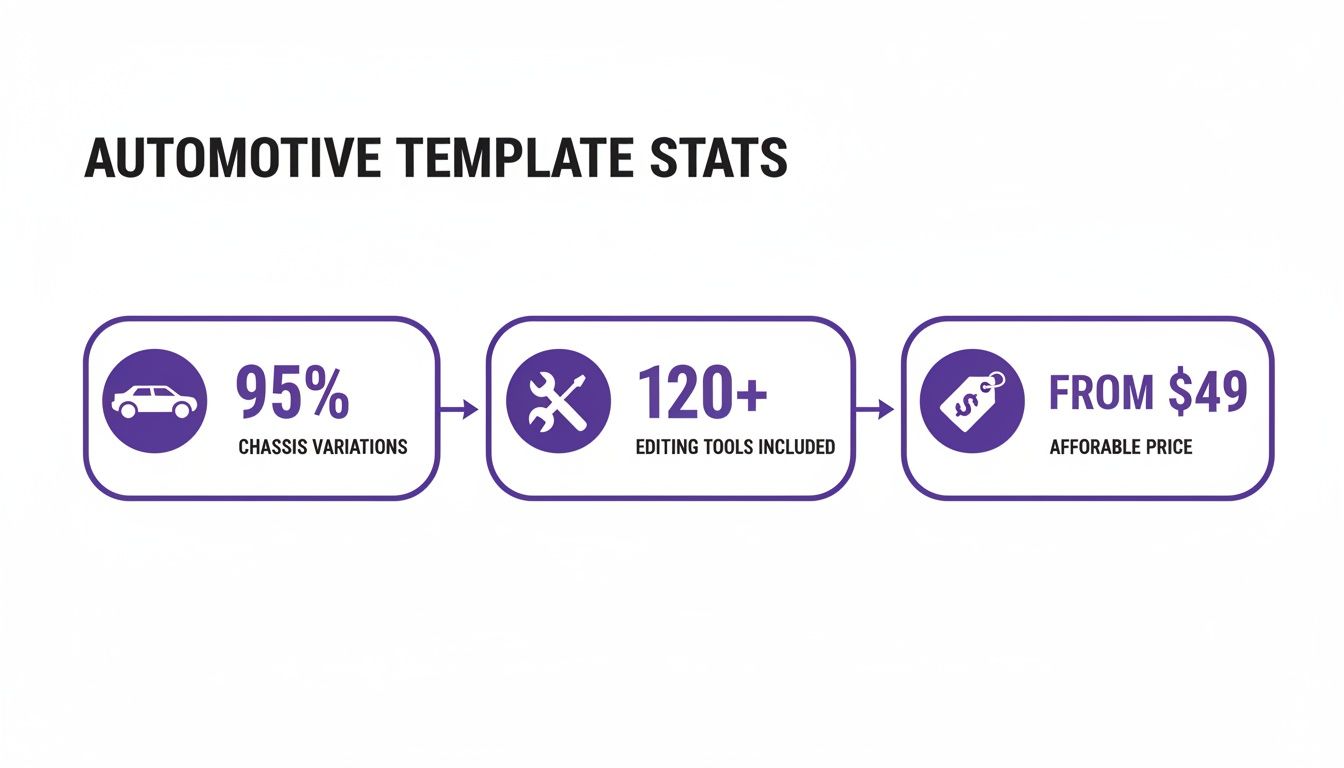
This shows how the template’s core structure, editing tools, and pricing come together to create a complete solution for your dealership.
High-Octane Lead Capture And Communication
A beautiful website that doesn't capture leads is like a showroom with no salespeople. It's just a missed opportunity. Your template needs to be peppered with lead capture forms—think "Request Info," "Schedule a Test Drive," or "Get Pre-Approved"—on every single vehicle detail page.
These forms have to be short, simple, and to the point. The easier you make it for an interested browser to raise their hand, the more qualified leads you'll get.
The whole point of your website is to turn an online looker into an in-person buyer. A high-converting site uses every tool in its arsenal to bridge that gap, making sure no potential customer slips through the cracks.
To really get this right, you need to integrate smart communication tools. Modern automotive live chat solutions are designed specifically to engage browsers and guide them toward a visit to your dealership.
Automatic VIN Decoding
Accuracy builds credibility, period. Automatic VIN decoding is a must-have tool that saves your team countless hours of tedious data entry and gives customers reliable, detailed information about each vehicle.
You just pop in the VIN, and the system instantly fills out the listing with all the correct specs—engine, transmission, factory options, you name it. This not only makes your life easier but also proves to shoppers that you're a trustworthy source of information.
To help you keep track of these non-negotiable elements, here's a quick checklist you can use when evaluating any template.
Essential Features Checklist for Automotive Templates
| Feature | Why It's a Must-Have for Your Dealership | Impact on Sales |
|---|---|---|
| Real-Time Inventory Sync | Eliminates manual data entry and ensures online listings are always 100% accurate, building customer trust. | Prevents losing sales from customers inquiring about already-sold vehicles. |
| Mobile-First Design | Caters to the majority of car shoppers who browse on their phones, providing a smooth, frustration-free experience. | Reduces bounce rate and keeps more potential buyers engaged with your inventory. |
| Strategic Lead Capture | Places clear calls-to-action (CTAs) on every vehicle page, making it easy for interested shoppers to contact you. | Directly increases the number of qualified leads for your sales team. |
| Automatic VIN Decoding | Saves time, reduces errors, and populates vehicle listings with accurate, detailed specs from the manufacturer. | Boosts buyer confidence with reliable, transparent vehicle information. |
| Fast Load Speed & Security | A quick site keeps users happy and ranks better on Google. Strong security protects both you and your customers. | Improves SEO visibility and keeps potential buyers on your site longer, increasing conversion chances. |
Using this checklist will ensure you’re focusing on the features that actually drive business, not just the ones that look flashy.
Blazing-Fast Performance and Security
In the online world, speed sells. A slow-loading website will send impatient visitors running for the hills, and it tells Google your site offers a poor user experience, hurting your search rankings.
Performance is a huge opportunity for car dealers. According to industry analysis, top automotive websites can generate significant monthly traffic, often outperforming standard e-commerce sites. Visitors also tend to stay longer when a site is fast and easy to use. A premium template is built on a clean, secure foundation, guaranteeing your pages load in a snap and that your customer data is always protected.
Getting Your Inventory Found on Google
You could have the most stunning website in the world, but it won't sell a single car if local buyers can't find it. An online showroom is useless if it’s buried on page 10 of Google’s search results. This is where automotive SEO makes all the difference, and thankfully, the right website template does most of the heavy lifting for you.

Many dealers hear "SEO" and immediately think of a complicated, expensive service. But modern templates come with this stuff "baked in" from the start. They’re built on a technical foundation specifically designed to communicate perfectly with search engines, helping your cars pop up the moment a local customer starts looking.
Speaking Google's Language with Structured Data
One of the most powerful built-in features is something called structured data, or schema markup. Think of it like a secret language that your website uses to tell Google all the critical details about your vehicles in a way it can instantly process.
Instead of Google just seeing a jumble of words on your vehicle detail page, structured data neatly labels everything. It essentially tells the search engine:
- "This is the make: Ford."
- "This is the model: F-150."
- "This is the price: $35,000."
- "This is the mileage: 42,000 miles."
This "translation" work is what enables Google to show your cars as rich, eye-catching results with key details right on the search page. That makes your inventory far more compelling and clickable than a plain old blue link. A deeper dive into SEO for automotive dealerships shows just how much these technical details matter for attracting real buyers.
Parking Your Cars on Google's Front Page
Beyond showing up in standard search, the real prize is getting into Google Vehicle Listings (GVL). This is the digital equivalent of parking your best inventory right on Google’s front lawn. When someone searches for a specific car, GVL can display a carousel of vehicles from local dealers—complete with photos, prices, and mileage.
Getting into Google Vehicle Listings is a game-changer for independent dealers. It puts your inventory on equal footing with massive franchise stores, directly in front of buyers who are actively shopping.
But there’s a catch: to get listed, your website has to feed inventory data to Google in a very specific, structured format. Trying to manage this manually is a technical nightmare.
A high-quality automotive template, however, handles this process automatically. It makes sure your inventory feed is always formatted correctly and ready for Google to pull from, giving you the best possible shot at being featured. This built-in readiness for both structured data and GVL is a core reason to use a specialized template. It automates the complex SEO work, freeing you up to do what you do best—sell cars.
How to Choose the Right Website Template Provider
Picking the right automotive website template is about more than just aesthetics. You're not just buying a design; you're choosing a partner for your digital showroom. The company behind the template is every bit as important as the template itself—their platform, support, and reliability will make or break your online success.
Think of it like choosing a parts supplier. A cheap part might look fine on the shelf, but if it fails on the road and there's no support, your whole operation grinds to a halt. It’s the exact same story with your website provider. You need a partner who delivers a solid product and is actually there to help when you hit a snag.
Evaluate the Ease of Use
First things first: how easy is it to actually use? Your website platform should feel intuitive, making your day-to-day work simpler, not adding another layer of complexity. The whole point of using specialized automotive website templates is to get away from technical headaches so you can focus on selling cars.
Before you commit to anything, give it a real-world test. Can you add a new car to your inventory in a few minutes without needing a user manual or a call to support? A platform truly built for car dealers should make this core task feel second nature. If it feels clunky or confusing during a free trial, it’s only going to get more frustrating down the line.
A great template provider builds a platform for dealership owners, not for web developers. The goal is to empower you to manage your online showroom with complete confidence, freeing you from technical dependency.
Look for a clean dashboard, logical menus, and straightforward tools. The best systems are designed around a dealer’s workflow, anticipating what you need to do and making common tasks—like updating a price or marking a vehicle as sold—ridiculously simple.
Analyze Scalability and Growth Paths
Where do you see your dealership in a year? Or five? Your website needs to be able to keep up. A provider that caters only to brand-new, small-lot dealers might not have the firepower you need once you start expanding your inventory or adding new services.
Look at the provider’s upgrade paths. How easy is it to move from a basic plan to one that handles more vehicles or adds advanced tools like a VIN decoder? A good partner offers clear, sensible tiers that let you grow without forcing you into a massive, expensive jump you aren’t ready for. You can find more details on this by exploring options for a flexible dealership website builder that adapts to your needs.
Test the Customer Support
When something inevitably goes wrong—and trust me, at some point, it will—the quality of your provider’s support is what really matters. A beautiful template is useless if your lead form suddenly breaks and you can't get anyone on the phone to help.
Before signing on the dotted line, put their support to the test.
- Response Time: Send a pre-sales question via email or chat. How long does it take to get a real response? Is the answer actually helpful?
- Knowledge: Does the support team understand the unique challenges car dealers face, or are they just reading from a script?
- Availability: What are their support hours? Do they offer help through channels that work for you, like phone, email, or live chat?
Demand Transparent Pricing
Finally, get out your magnifying glass and go over the pricing structure. Hidden fees and surprise up-charges can turn an affordable template into a major budget headache. A provider you can trust will be completely upfront about every cost involved.
Make sure you have clear, unambiguous answers to these questions:
- Are there any setup fees or hidden installation charges?
- What is the exact cost for hosting and connecting my domain?
- Are critical features like SSL security and regular backups included, or are they extra?
- What happens if I go over my plan’s inventory or traffic limits?
A provider with straightforward, transparent pricing is showing you they’re confident in the value they offer and that they respect your business. That clarity is what allows you to make a smart decision that fits your budget and sets you up for long-term success.
Common Mistakes That Sabotage Your Website's Success
Investing in a powerful automotive website template gives you a massive head start, but even the best foundation can be shaky if you make a few common, easily avoidable mistakes. Think of your new website template as a high-performance engine; it has all the potential in the world, but it won't get you anywhere without the right fuel and maintenance.
A few simple missteps, especially in how you present your inventory, can bring your sales momentum to a screeching halt.

It's easy to get caught up in the technical setup and completely overlook the most critical part—the content that actually sells the cars. These small errors don't just look unprofessional; they actively push potential buyers away and straight to your competitors.
The good news? These pitfalls are incredibly easy to fix once you know what you're looking for.
Low-Quality Photos and Generic Descriptions
If there's one mistake that kills online sales faster than anything else, it's using grainy, poorly lit vehicle photos. Your pictures are your digital handshake. Low-quality images instantly scream "unprofessional" and suggest you don't care about your own inventory. Buyers expect to see crisp, clear shots from every conceivable angle, including close-ups of the interior.
Almost as damaging are the generic, copy-pasted vehicle descriptions. Just listing the factory specs is lazy and does absolutely nothing to sell the car. Every description is a sales opportunity you can't afford to waste.
- The Mistake: Using a single, blurry exterior photo and a description that just says, "2018 Ford Escape, runs great."
- The Fix: Upload at least 15-20 high-resolution photos for every single vehicle. Then, write a unique description that highlights real selling points, like "perfect for families with its brand-new all-weather tires and massive cargo area."
Your website’s vehicle detail page is your virtual showroom. If the car looks dirty, the photos are dark, or the description is lazy, you’re telling customers you don’t value their time or your own inventory.
Slow Lead Follow-Up and Poor Mobile Experience
Getting a lead is only half the battle. A customer who takes the time to fill out your "Request Info" form is at their absolute peak interest. Letting that lead sit for hours—or worse, a day—is the digital equivalent of watching them walk around your physical lot for 20 minutes without a single salesperson saying hello. Their excitement fades, and they've already moved on to the dealership that responds instantly.
Another deal-breaker is neglecting the mobile experience. Let's be clear: the vast majority of your customers are shopping on their phones, often while standing on another dealer's lot. If your site is slow, the buttons are too small to tap, or the inventory is a pain to browse on a small screen, you are actively frustrating your main audience. They won't wait for it to load. They’ll just leave.
A great template is built for mobile, but it's on you to ensure your images and content are optimized for speed and clarity on those smaller screens.
Your Top Questions About Automotive Templates Answered
Jumping into the world of automotive website templates can feel like a lot, especially when you're an independent dealer juggling a dozen other things. You've got questions, and you need straight answers to make a smart decision for your business. Let's clear up some of the most common ones we hear.
Think of this as a quick-start guide to the practical side of things. We’ll cover everything from the technical bits to the real-world impact on your bottom line, so you can see exactly how the right template helps you sell more cars.
Can I Use My Own Domain Name with a Template?
Yes, absolutely. Any professional automotive template provider worth its salt is designed with your branding in mind. Most will give you a temporary subdomain to get you up and running right away, but connecting your own custom domain (like www.yourdealership.com) is a standard—and crucial—feature.
This isn’t just a cosmetic change. Your domain is your digital storefront sign. It builds trust, reinforces your brand, and is a cornerstone of good, long-term SEO that helps local buyers find you first.
How Much Technical Skill Do I Need?
Close to zero. Seriously. These platforms are built for car people, not coders. The whole point is to give you a simple dashboard where you can add inventory, update your business hours, and check on new leads without ever touching a line of code.
Your provider takes care of all the technical headaches—security patches, server upkeep, and software updates. This leaves you free to focus on what you do best: selling cars. The goal is to get technology out of your way, not add another problem to your plate.
It’s all about empowering you to control your online presence without needing to hire a web developer or take a programming class.
Will a Template Website Help Me Rank on Google?
A good one will, yes. A high-quality automotive template gives you the solid technical foundation that Google loves. Things like lightning-fast load times, a design that works perfectly on phones, and built-in vehicle schema are huge for SEO and come standard right out of the box.
You still need to do your part with great photos and honest, detailed vehicle descriptions. But the template handles the complex, technical SEO that trips up so many dealers. It’s built to speak Google’s language, making your inventory more visible in local searches and putting you ahead of competitors stuck with slow, outdated sites.
What Is the Real Difference Between a Generic and an Automotive Template?
It all comes down to specialization versus a whole lot of compromises. A generic website builder is like an empty garage—you have to bring in all your own tools. You'd need to find, pay for, and somehow stitch together a bunch of clunky plugins for inventory, VIN decoding, and lead forms. The result is often slow, buggy, and frustrating for customers.
An automotive-specific template, however, is a fully equipped, professional service bay. All the essential tools are built right in and designed to work together perfectly from the start. It's the difference between trying to rebuild an engine with a single adjustable wrench and having a full, professional mechanic's toolkit designed for that exact job.
Ready to launch a professional, sales-focused website without the technical headaches? AutoFire provides clean, SEO-optimized automotive website templates designed to get you online and capturing leads in minutes. Start for free and see how simple it is to build a dealership site that works.