 ™
™

The best website for used car sales is more than just an online brochure; it's a high-performance digital showroom. The platforms that truly move the needle for dealerships today are the ones that blend automated SEO, seamless inventory management, and a mobile-first design. The goal is simple: attract and convert online shoppers before they even think about visiting the lot.
Why Your Dealership Website Is Your Digital Showroom
Let's be honest, the days of a dealership website being just a glorified business card are long gone. Today, your website is your primary sales and marketing engine—a virtual showroom that never closes. Modern car buyers start their hunt online. They're researching models, comparing prices, and checking out local dealerships long before they ever pick up the phone.
This fundamental shift in how people buy cars means a high-performance, SEO-optimized, and mobile-friendly site isn't a luxury; it's essential for survival. For independent dealers, this is a huge challenge. You aren't just up against the dealership down the street. You're competing with massive franchise operations that have dedicated marketing teams and budgets to match.
The Core Challenges for Independent Dealers
To get ahead, you have to tackle a few key hurdles that can really limit your reach and profitability. Nailing these is the first step toward picking the right website platform.
- Limited Online Visibility: If your site doesn't have strong SEO or an integration with Google Vehicle Listings, your inventory is practically invisible to local buyers who are actively searching for the exact cars you have in stock.
- Technical Overload: Who has time to manage website hosting, security updates, and design tweaks? That can feel like a full-time job, pulling you away from what you actually do best—selling cars.
- Ineffective Lead Capture: An old, clunky website doesn't just look bad; it fails to turn visitors into actual leads. Potential customers just end up clicking away to your competitors.
The market trends only reinforce how critical this is. According to Grand View Research, the global used car market is projected to see significant growth, demonstrating the massive digital opportunity for dealers. With North America holding a substantial market share, a powerful digital strategy is what separates the leaders from the laggards. You can dig into more used car market insights on Grand View Research.
Finding a Competitive Advantage
The good news? Modern website platforms are built to level the playing field. The right solution automates the technical heavy lifting, boosts your online visibility, and makes your sales process much smoother. This guide will walk you through a detailed comparison to help you find the best website for used car sales, so you can overcome these challenges and truly compete.
Here’s a quick look at how things have changed:
| Key Dealer Challenge | Traditional Website Approach | Modern Platform Solution |
|---|---|---|
| Search Visibility | Requires manual SEO work & expertise | Automated SEO & Google Vehicle Listings sync |
| Technical Maintenance | Requires hiring developers for updates | Handled by the platform (hosting, security) |
| Lead Generation | Basic contact forms, low conversion | Integrated lead capture & management tools |
| Mobile Experience | Often outdated and slow on phones | Mobile-first design for on-the-go shoppers |
What Every Modern Dealer Website Actually Needs
When you're shopping for a website platform, it's easy to get lost in a sea of features. But what separates a high-performing site from a simple online brochure? It comes down to a few core elements that work together to attract real buyers and make your life easier.
Think of your website as your best salesperson—one that works 24/7 without a break. It needs to be visible, persuasive, and incredibly efficient at turning a casual browser into a hot lead. Let's break down the non-negotiables.

Advanced SEO and Google Vehicle Listings
If buyers can't find you online, you don't exist. It’s that simple. Solid Search Engine Optimization (SEO) is the engine that drives local car shoppers directly to your inventory. Your site needs to be built with clean code and load lightning-fast, with every vehicle getting its own dedicated, search-friendly page automatically.
Even more important today is a direct pipeline to Google Vehicle Listings (GVL). This is the feature that gets your cars, complete with photos and pricing, to show up right in the Google search results when someone nearby looks for a "used Honda CR-V." It's one of the most powerful, high-intent marketing channels available, and it's completely free.
A platform with automated GVL integration is a game-changer. It eliminates hours of manual work and ensures your vehicles are constantly visible to the most motivated shoppers at the exact moment they are searching.
A Mobile-First User Experience
Let's face it: your customers are shopping on their phones. They’re scrolling through inventory on their lunch break, comparing prices in line at the grocery store, and checking out your dealership from their couch. If your website is a clunky, slow, or broken mess on a smartphone, you are actively turning away business.
A true "mobile-first" approach isn't about just making your desktop site fit on a smaller screen. It’s about designing the experience from the ground up for a thumb, with big buttons, readable text, and simple navigation. The goal is to make it ridiculously easy for a customer to find a car, see the details, and contact you in just a couple of taps.
Automated Inventory Management
Manually adding and removing cars from your website is a massive time-sink and a recipe for mistakes. Your website platform absolutely must automate this. The second you scan a VIN or add a vehicle to your management system, it should pop up on your site as a professional, fully-detailed listing.
This kind of automation frees you up to do what you do best: buy and sell cars. The key tools here are:
- VIN Decoding: Automatically pulls in all the specs, features, and options.
- Photo Management: Simple drag-and-drop for uploading and arranging high-quality images.
- Real-Time Syncing: Instantly removes sold cars so you don't frustrate potential buyers.
Integrated Lead Capture and CRM Tools
A pretty website that doesn't bring in leads is just an expensive digital billboard. To turn those website visitors into actual sales opportunities, you need smart, easy-to-use forms on every vehicle page. These should invite shoppers to ask a question, check availability, or schedule a test drive.
Once that lead comes in, the platform should organize it for you in a simple Customer Relationship Management (CRM) tool. This lets you track every inquiry, respond quickly, and manage your sales pipeline without paying for extra software. You can explore a full list of dealership website features to see how these tools should work together to turn clicks into customers.
Simplicity of Launch and Maintenance
Finally, the best website platform is one you can actually use without needing an IT degree. As an independent dealer, you need a solution that’s dead simple to get running and requires zero technical upkeep.
Find a platform that handles all the hosting, security, and software updates for you. This lifts a huge weight off your shoulders, letting you focus 100% on your dealership. A system you can set up in minutes, not months, gives you an immediate edge over the competition.
Comparing Top Website Platforms for Independent Dealers
Picking the right website for your used car lot means sorting through a ton of options, each with its own philosophy on how a dealership should operate online. For an independent dealer, this isn't just a technical decision. It’s about finding a partner that gets your business goals, matches your comfort level with technology, and can actually help you grow.
Let's break down the three main types of platforms you'll encounter: a modern, all-in-one system like AutoFire™; flexible DIY builders like Wix or Squarespace; and the old-guard, traditional dealer platforms. The best fit for you hinges on what you truly need for SEO, inventory management, and getting more leads.
The All-in-One Solution: AutoFire
Modern platforms like AutoFire were built from the ground up to solve the real-world headaches independent dealers face every day. They bundle everything—hosting, security, design, and car-specific sales tools—into one simple subscription. The whole point is to get the tech out of your way so you can just focus on selling cars.
AutoFire is a perfect example of this. Its biggest strength is automation, especially for your inventory and SEO. When you add a car, the platform instantly builds a search-optimized vehicle detail page (VDP) and automatically syncs it with Google Vehicle Listings. This one feature alone can put your inventory in front of thousands of local buyers without you ever having to learn what "SEO" means.
Getting started is also incredibly fast. You can have a professional-looking, high-performing website live in minutes, not weeks. That's a huge win if you're just starting out or if your current site is bleeding customers. While you don't get the same pixel-perfect design control as a DIY builder, the trade-off is a guaranteed smooth experience that works perfectly on mobile. The focus here is on results—generating real leads and moving metal. You can see how these specialized designs translate into sales in our guide to used car dealer website templates.
The DIY Builder: Wix or Squarespace
DIY website builders give you total creative freedom. If you have a strong brand vision and enjoy getting your hands dirty with design, platforms like Wix or Squarespace can look really attractive. They give you a blank slate and drag-and-drop tools to build pretty much anything you can imagine.
But all that freedom comes with a lot of responsibility. A standard Wix site isn't designed to sell cars. You’ll have to hunt down third-party apps and plugins to handle essentials like inventory feeds, VIN decoding, and lead forms. This patchwork approach can get complicated and expensive fast, with each plugin adding another monthly fee and another potential point of failure.
Key Differentiator: The biggest hurdle with DIY builders is the complete lack of automated, auto-specific SEO. You can optimize pages by hand, but there’s no built-in system to get your cars listed on Google Vehicle Listings—a non-negotiable for any modern dealership. You are 100% responsible for all the technical SEO, security updates, and maintenance.
This path really only makes sense for dealers who have the time, skill, and desire to be their own webmaster. You can build something unique, but the effort to replicate the core sales functions of a dedicated auto platform is massive.
The Traditional Dealer Platform
Traditional dealer platforms have been around for a long time. They typically serve the big, established franchise stores and come packed with a huge, if sometimes clunky, set of features. Their main claim to fame is deep integration with major Dealer Management Systems (DMS) and other legacy software common in the industry.
For a large, multi-lot operation with complex internal processes, that direct DMS connection can be a game-changer. These platforms offer powerful backend tools for managing just about every digital aspect of the business.
The catch? Cost and complexity. Traditional platforms often come with steep setup fees, lock you into long-term contracts, and have a significant learning curve. Their user interfaces can feel dated compared to modern solutions, and simple tasks like changing a banner image might require you to submit a support ticket. For a smaller independent dealer, the feature set is often overkill and the price tag is simply out of reach.
Side-by-Side Platform Breakdown
To make the differences crystal clear, here’s a look at how these three platform types stack up against the key needs of a modern used car dealership. This table provides a side-by-side look at how different website solutions stack up against the key needs of a modern used car dealership, from technical setup to sales-focused features.
Platform Comparison for Independent Dealerships
| Feature | AutoFire | DIY Builders (e.g., Wix) | Traditional Dealer Platform |
|---|---|---|---|
| Google Vehicle Listings | Automated & Fully Integrated | Manual Setup Required | Often available, but may require extra configuration or fees. |
| Ease of Launch | Extremely Fast (Minutes) | Moderate to Slow (Days/Weeks) | Slow (Weeks/Months) |
| Technical Maintenance | None (Fully managed) | High (Dealer is responsible) | Low (Managed by provider) |
| Inventory Management | Built-in & Automated | Requires third-party plugins | Deep DMS integrations available |
| Upfront Cost | Low to None | Low (plus plugin costs) | High (Setup fees are common) |
| Mobile Experience | Mobile-First by Design | Dependent on template/user skill | Can be inconsistent or dated |
As the comparison shows, the "best" platform is entirely situational. A new dealer flying solo will get the most value from AutoFire's speed and automation. On the other hand, an established dealership heavily reliant on a specific DMS might find a traditional platform's integration worth the higher cost.
Make no mistake, having a strong digital presence is no longer optional. The digital used car market is experiencing explosive growth, which means a website that automates your marketing and simplifies lead capture isn't a luxury—it's a critical competitive advantage. You can check out the complete used car market forecast on Research and Markets. Ultimately, your choice should be a direct reflection of your resources, priorities, and where you want to take your dealership.
Choosing The Right Platform for Your Dealership's Growth Stage
Finding the best website for used car sales isn't about chasing a single "perfect" platform. It's really about matching the tech to where your dealership is right now—your size, your goals, and how comfortable you are with the technical side of things. A solution that's a godsend for a new solo operator can quickly become a bottleneck for an established dealership with multiple lots.
Think of it this way: your business stage dictates the trade-offs you're willing to make between speed, features, and cost. Each type of dealer has a completely different set of needs. The right platform should feel like a natural part of your sales process, not another technical headache you have to manage. Getting this right means you're investing in a tool that helps you win today and can grow with you tomorrow.
The New Solo Operator: Speed and Simplicity
If you're just getting started, your two most precious assets are time and money. You need a website that's live yesterday without a punishing learning curve or a big price tag. The only thing that matters is getting a professional-looking site up so you can start showing off your first few cars.
For a new dealer, any technical friction is a deal-breaker. You can't afford to be messing around with complex setups, managing plugins, or trying to figure out SEO from scratch. The name of the game is automation—a solution that handles the digital grunt work so you can stay focused on what you do best: buying and selling cars.
- What You Need: Affordability, a fast launch, and automated inventory listings.
- Best Fit: This is exactly why all-in-one SaaS platforms like AutoFire exist. They take all the technical heavy lifting off your plate and can get your inventory online in minutes, fully integrated with Google Vehicle Listings right out of the box.
The Growing Independent Dealership: Advanced Tools
Once your dealership starts to pick up steam, your needs change. You're not just trying to get online anymore; you're building a brand and fine-tuning your sales funnel. That means you need more sophisticated tools to cut through the noise and manage a bigger, faster-moving inventory.
At this point, things like a custom domain (YourDealership.com), automatic VIN decoding, and some basic market analysis tools are no longer "nice-to-haves"—they're essential. You need a platform that helps you build a real brand identity while making it easy to create the kind of detailed, professional vehicle listings that pull in serious buyers.
This decision tree gives you a visual on how to think about your options based on your main goal.
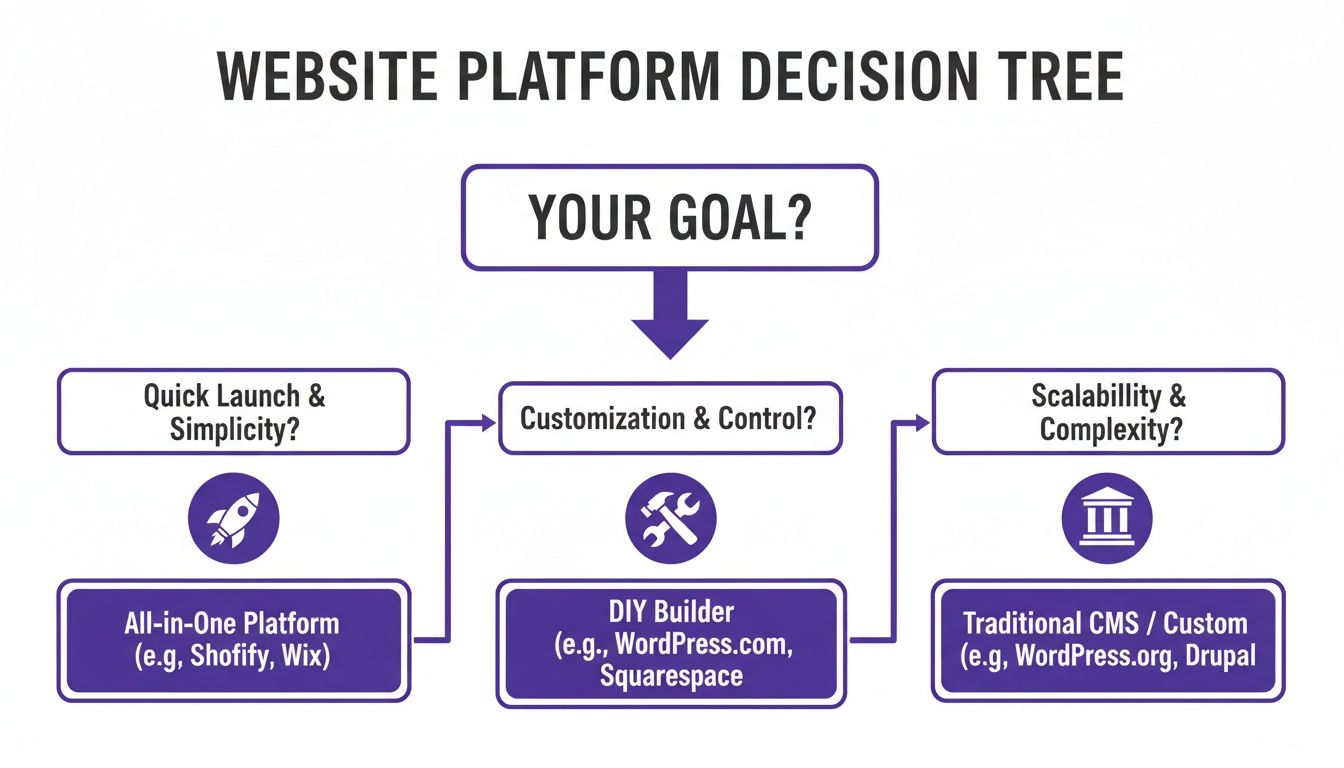
As you can see, all-in-one solutions are built for speed and sales, while the other paths require you to be much more hands-on with the technical side of things.
A growing dealership has to strike a balance between powerful features and ease of use. The right platform gives you the tools you need to scale without turning you into a full-time IT manager.
The Established Multi-Lot Operation: Agility vs. Legacy
For a big, established dealership with multiple locations, the conversation often gets complicated by legacy systems. You might already have a clunky, traditional website that’s deeply woven into your long-standing Dealer Management System (DMS). The big question is: Is that deep integration worth the high costs and lack of flexibility?
Modern SaaS platforms present a very compelling alternative. They’re more cost-effective, deliver a much better mobile experience for your customers, and let you adapt to market shifts in real-time. While they might not have the same custom-coded connection to every old-school DMS, their built-in marketing automation and SEO power often drive a far better ROI by generating more organic leads.
For larger operations, it boils down to a strategic choice:
- Stick with Tradition: You can prioritize the deep DMS hookup, but you'll have to accept the higher price tag and slower pace that come with a legacy platform.
- Embrace Modern Agility: Or, you can opt for a modern, cost-effective platform that excels at lead generation and customer experience, even if it requires tweaking a few of your internal processes.
Knowing which stage you're in is the first and most important step. It's how you pick a platform that doesn't just solve today's problems but sets you up for success down the road.
How to Nail the Launch of Your New Dealership Website
You've picked out the best website platform for your used car dealership—that's a huge win. But a top-tier platform is only as good as its launch. A sloppy, rushed setup can trip you up before you even get started, making all those powerful features useless. The good news? Most modern platforms are built to make this process surprisingly simple, breaking it down into a few key steps.
The real goal here is to get from sign-up to a live, lead-generating digital showroom without pulling your hair out. A smooth launch builds the foundation for everything that follows: attracting the right buyers, capturing their information, and, of course, selling more cars. It's about making sure every piece, from your VDP photos to your "Contact Us" forms, is ready for showtime the moment you go live.
Your Pre-Launch Checklist
Before flipping the switch, a little prep work goes a long way. These are the non-negotiables to ensure your website looks professional and works perfectly for customers from day one.
- Get Your Inventory Data Ready. Your cars are the main event. You need high-resolution photos from every angle—inside and out. Write honest, detailed descriptions that call out the best features and the vehicle's condition. This is your first impression.
- Lock Down Your Domain and Branding. Grab a professional domain name that’s easy for customers to remember (like
YourDealership.com). Make sure you have your logo files handy to upload so your brand looks consistent from the get-go. - Set Up Your Lead Forms. Think about what info you actually need from a potential buyer. Customize your contact forms to make it dead simple for someone to ask about a car, book a test drive, or get pre-qualified for financing.
Must-Have Integrations to Get Found
Once the basics are in place, it’s time to connect your site to the tools that matter. These integrations give you a direct line into how your site is performing and, more importantly, help local car shoppers find you.
- Google Analytics: This is a free, indispensable tool. It tells you exactly how people find your site, which cars get the most clicks, and how visitors navigate your pages. It’s like having a map of customer behavior.
- Google Business Profile: Linking your website to your Google Business Profile (GBP) is critical for local SEO. This ensures your dealership’s address, hours, and website show up correctly in Google Maps and local search results when someone is looking for a "used car dealer near me."
With the used vehicle market remaining a significant part of the U.S. economy, every digital advantage counts. For independent dealers, a clean website launch is how you compete. The right platform handles inventory, automates SEO, and captures leads on mobile, turning a technical headache into a simple, money-making task. For more on this, check out the outlook for the future of used car sales on NIADA.com.
Moving from an Old Website? Read This First.
If you already have a website, migrating to a new one requires extra care. One wrong move and all the search engine authority you’ve built up can vanish overnight, making your inventory invisible to online shoppers.
A seamless migration is all about telling search engines where your old pages have moved. Failing to do this is like moving your dealership to a new address without leaving a forwarding note—customers simply won't find you.
Your migration plan needs to include:
- URL Redirects: Map every old URL to its new counterpart and set up 301 redirects. This tells Google the page has moved for good and transfers most of its SEO value.
- Content Transfer: Don't leave good content behind. Make sure your blog posts, customer reviews, and other valuable pages are moved over to the new site.
- Final SEO Check: After you go live, open up Google Search Console and hunt for any broken links or crawl errors. Fix them immediately.
Following these steps takes the mystery out of the launch process. It gives you the confidence to manage the transition yourself without hiring an expensive agency. For more pointers, take a look at our guide on creating an engaging dealership website with these essential tips.
Common Questions We Hear From Dealers
Picking the right website platform can feel overwhelming. You're balancing SEO, features, ease of use, and, of course, cost. To cut through the noise, we've answered some of the most common questions we get from independent dealers. These are straight answers, based on years of experience, to help you feel confident in your choice.
Think of this as a quick-start guide to the essentials. We'll cover everything from must-have integrations to branding and long-term costs, so you can pick a platform that actually helps you sell more cars.
How Important Is Google Vehicle Listings Integration?
Honestly? It's a non-negotiable in today's market. Google Vehicle Listings (GVL) is what gets your inventory to show up directly in Google search results when someone nearby is looking for the exact car you have on your lot. It's essentially free advertising aimed at buyers who are ready to pull the trigger.
Platforms that automatically sync your inventory with GVL are worth their weight in gold. They save you from the nightmare of manual data entry and make sure your cars are always in front of the right people. If your website provider doesn't offer this, you're leaving a massive amount of money on the table and letting your competitors get the first click.
Can I Use My Own Domain Name?
Yes, and you absolutely should. Any serious website platform for dealers will let you use your own custom domain (like YourDealership.com). This isn't just a nice-to-have feature; it's fundamental to building a brand that customers recognize and trust.
A custom domain also anchors your long-term SEO efforts, helping you build authority with search engines over time. The setup is usually painless—you just have to update a few settings where you registered your domain to point it to your new website.
Key Takeaway: Using your own domain name turns a generic webpage into a legitimate business destination. It tells both shoppers and Google that you're a serious, established dealership.
What Is The Difference Between A SaaS Platform And A Custom Website?
This is a big one, and it comes down to your budget, time, and technical comfort level.
A SaaS (Software-as-a-Service) platform is what most dealers use. You pay a monthly or annual subscription, and you get an all-in-one package that includes the website, hosting, security, software updates, and car-dealer-specific tools like inventory management and lead forms. The biggest wins here are the low upfront cost and the fact that you don't have to worry about maintenance.
A custom-built website is exactly what it sounds like—a site built from the ground up just for you by a developer. While you get total control over the design, the initial price tag is steep, often running into the tens of thousands of dollars. On top of that, you're on the hook for ongoing costs for hosting, security, and paying a developer every time you need an update. For most independent dealers, it's just not practical.
How Do I Know If My Website Is Mobile-Friendly?
Don't just take your web provider's word for it—test it yourself. The best way is to pull out your phone and act like a customer. Navigate your own site. Can you easily tap the buttons? Is the text readable without zooming in? How frustrating is it to fill out a form?
For a more technical answer, use Google's free Mobile-Friendly Test tool. Just plug in your website's address, and it will give you a clear "yes" or "no" on whether it meets Google's standards. With so many car shoppers starting their search on a phone, a clunky mobile site is a surefire way to lose sales.
Ready to launch a dealership website that attracts buyers and drives sales without the technical headaches? AutoFire provides an all-in-one platform with automated Google Vehicle Listings, mobile-first designs, and a launch process so simple you can be online in minutes. Build your digital showroom today.
