

A great car showroom website is more than just an online catalog. It needs to be a strategic, conversion-focused digital retail experience. Think of it as building an online presence that expertly guides a potential buyer from their initial research right through to scheduling a test drive. The goal is to combine intuitive navigation, mobile-first layouts, and clear calls-to-action to turn those clicks into actual customers.
Building Your Digital Showroom's Blueprint
Before you even think about code or design templates, a successful dealership website starts with a solid blueprint. This foundational stage isn't about picking colors; it's about getting inside your customer's head and designing a digital journey that feels completely natural. You want to anticipate what they need and guide them smoothly toward buying a car.
This is what turns a static, brochure-style site into a dynamic sales engine. The reality is, the online journey is where almost every vehicle purchase begins now. Industry studies consistently show that a vast majority of car buyers start their research online. With mobile browsing accounting for a significant portion of automotive site traffic, a mobile-first approach is no longer a "nice-to-have"—it's the absolute baseline.
Mapping the Customer Journey First
Your first move should be to map out the customer journey. Seriously, put yourself in their shoes. What’s the first thing they want to see? Your inventory, right? From there, they’ll probably start looking for financing options, trade-in value tools, or your dealership's location and hours.
A logical site structure naturally flows from this journey map. Your most important pages need to be easily accessible from anywhere, usually through a clean and simple main navigation menu.
- Homepage: This is your digital front door. It needs to showcase current promotions, have a big, obvious inventory search bar, and offer clear paths to key sections like "New Cars," "Used Cars," and "Service."
- Inventory Pages (VLP/VDP): This is the heart of your website. The Vehicle Listing Page (VLP) is for browsing, but the Vehicle Detail Page (VDP) is where the magic happens—where real leads are generated.
- Financing & Tools: Pages for pre-approval applications, payment calculators, and trade-in estimators are huge for building trust and capturing high-intent leads.
- Service Center: A dedicated section for your existing customers to book appointments and find service specials is crucial for driving repeat business.
This process—mapping the journey, defining the structure, and then focusing on mobile—is the key.
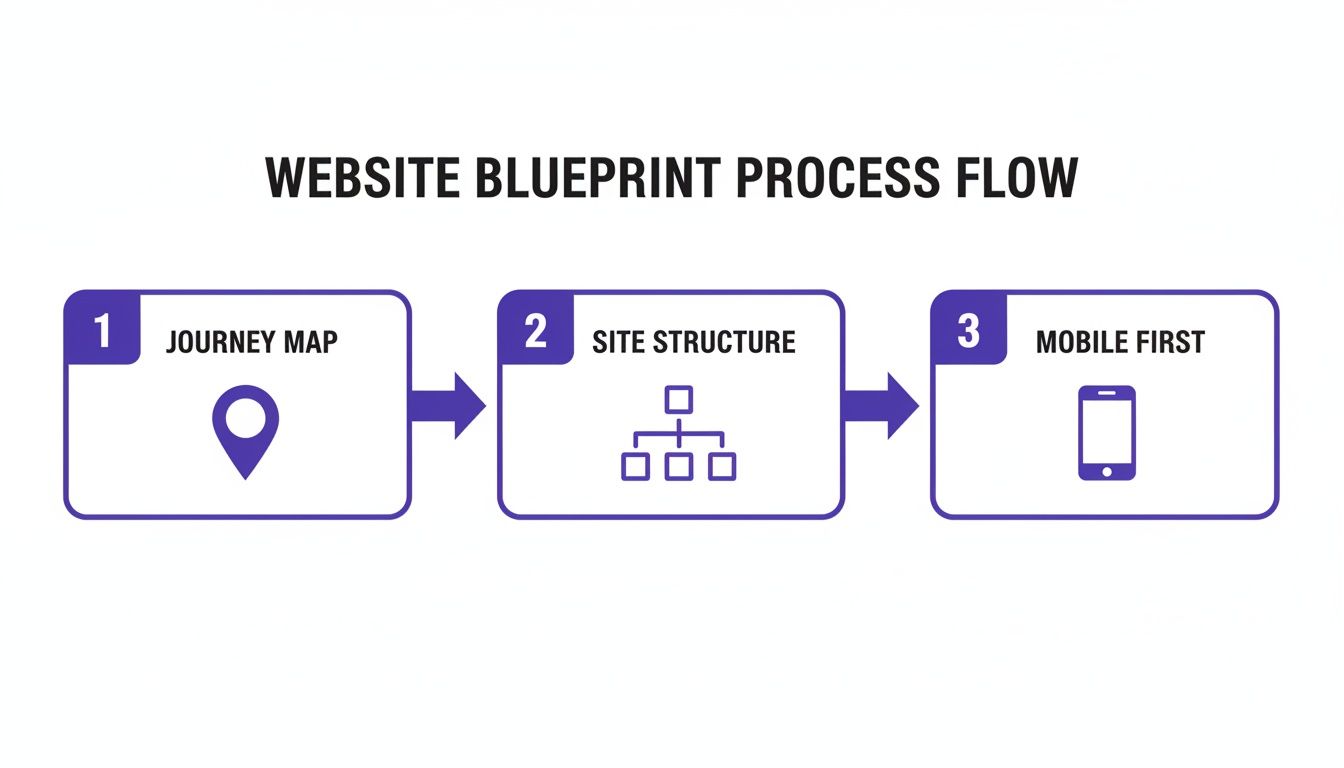
As you can see, the flow from understanding the customer to structuring the site and prioritizing mobile is a non-negotiable sequence for success.
A well-planned structure anticipates a buyer's needs at every stage. The table below breaks down the core pages every independent dealership site should have and what their specific job is.
Core Website Structure for a Car Dealership
| Page/Section | Primary Goal | Key Features |
|---|---|---|
| Homepage | Capture attention & guide traffic | Prominent search bar, featured vehicles, clear navigation, trust signals (reviews) |
| Vehicle Listing Page (VLP) | Facilitate easy browsing | Advanced search filters (make, model, price), high-quality thumbnails, sorting options |
| Vehicle Detail Page (VDP) | Drive lead conversion | Multiple high-res photos/video, detailed specs, transparent pricing, CTAs |
| Financing/Pre-Approval | Capture high-intent finance leads | Secure online application form, payment calculator, clear privacy policy |
| Trade-In Valuation | Generate seller leads & appointments | Simple form (VIN/make/model), instant estimated value, clear next steps |
| Service Center | Retain existing customers | Online appointment scheduling, service specials, list of services, contact info |
| About Us/Contact | Build trust and provide location info | Dealership story, staff photos, map, hours of operation, contact form/phone |
Each of these pages plays a vital role in moving a visitor from a casual browser to a serious lead in your CRM.
Why a Mobile-First Approach Is Non-Negotiable
Designing for mobile devices first isn’t just a trend; it's the standard. It means you create the layout for the small screen first—optimizing for thumbs and touch—and then adapt it for desktops. Think thumb-friendly menus, large clickable buttons, and images that load fast.
A slow or clunky mobile experience is one of the fastest ways to lose a potential customer. If a user has to pinch and zoom to read vehicle specs or struggles to tap a tiny "Contact Us" button, they will simply leave and go to a competitor's site.
This approach forces you to prioritize what's most important. Your vehicle photos, pricing, and calls-to-action will always be front and center, no matter the device. Whether you're using a dedicated platform or looking into options with a dealership website builder, this principle should guide every single design choice you make.
Designing Vehicle Pages That Convert Browsers Into Buyers
If your homepage is the digital front door to your dealership, then your Vehicle Detail Pages (VDPs) are the individual showrooms where the real action happens. This is where a casual browser turns into a serious lead, and it’s arguably the most critical part of your entire website. A lackluster VDP is a dead end; a great one is a lead-generating machine.
Let's be honest, today's car buyer has high expectations. They want to kick the virtual tires and explore every inch of a vehicle from their couch before they even think about visiting you. A few low-resolution, static photos just won’t cut it anymore.
Beyond the Static Photo Gallery
A modern VDP has to be a rich, interactive experience. The entire goal is to build trust and answer questions visually before a customer even has to ask. This isn't about adding fancy bells and whistles; it's about using tools that directly impact your bottom line.
Think way beyond a simple slideshow. Your visual presentation should include:
- A High-Resolution Photo Gallery: Aim for a comprehensive set of professional, well-lit photos. Get every angle—exterior, interior, the engine bay, trunk space, and even close-ups of key features or minor imperfections. Transparency is king.
- Simple Walk-Around Videos: A quick 60-90 second video tour gives a far better sense of the car's presence and condition than photos alone. It feels real.
- 360° Interior/Exterior Views: These tools are game-changers. They let a potential buyer "sit inside" the car or spin it around, giving them a sense of control and a much deeper feel for the vehicle.
The impact here is huge. Industry data often shows that dealerships using interactive viewers on their VDPs can see a significant jump in page engagement compared to those sticking with static galleries.
Presenting Information That Sells
Visuals grab attention, but clear, organized information is what builds the confidence a buyer needs to take the next step. Nobody wants to read a wall of text. You need to structure your vehicle data so it's clean, scannable, and easy to digest.
Your VDP's main job is to eliminate buyer hesitation. Every piece of information, from mileage to the vehicle history report, must be easy to find and completely transparent. This is how you build trust before you ever pick up the phone.
Break down the vehicle details into logical, easy-to-read sections. I'm a big fan of using tabs or accordion-style dropdowns to keep the layout from feeling cluttered while still packing in all the necessary info.
Key Information Blocks:
- Vehicle Summary: This is your "above the fold" section. It needs the year, make, model, trim, price, and mileage, plus a few key selling points.
- Detailed Specifications: List out all the features, engine details, MPG, and other technical data. Using icons here makes it much more scannable.
- Vehicle History: A prominent, clickable link to the CARFAX or AutoCheck report is non-negotiable. It’s one of the biggest trust signals you can offer.
- Dealer Notes: Ditch the generic, auto-filled descriptions. Write a unique, human-readable paragraph that highlights what makes this specific car a great buy. For more ideas, check out our guide on crafting compelling car listings to boost sales.
This structured approach makes your listings feel professional and trustworthy, instantly setting you apart from competitors who just dump raw data onto the page.
Guiding Users with Clear Calls to Action
Finally, a high-converting VDP tells the user exactly what to do next. Your Calls-to-Action (CTAs) need to be prominent, persuasive, and varied enough to appeal to people at different stages of their buying journey.
Don't just slap a single "Contact Us" button on the page and call it a day.
Give potential buyers multiple, clear pathways to engage with you:
- Primary CTA: Your biggest, boldest button should be for high-intent actions like "Schedule Test Drive" or "Check Availability."
- Secondary CTAs: Capture leads who are a bit further down the funnel with options like "Get Pre-Approved" or "Value My Trade-In."
- Interactive Tools: An integrated payment calculator is a brilliant tool. It lets users explore monthly payments on their own terms, making the price feel more tangible and a lot less intimidating.
When you combine immersive visuals, scannable information, and strategic CTAs, your VDPs will do more than just display cars—they will become your hardest-working salespeople.
Winning the Local Search Battle with Automotive SEO
A great-looking website is a fantastic start, but it's only half the story. If your potential customers can't find you online, that beautiful site might as well be invisible. This is where a smart automotive SEO strategy comes in, turning your digital showroom into a magnet for local buyers.
The goal isn't just to rank for your dealership's name. You need to show up the moment someone in your town searches for "used Ford F-150 near me" or "best family SUVs in [Your City]." That's where the real competition is, and that's how you win new business.
Dialing in Your Vehicle Detail Pages
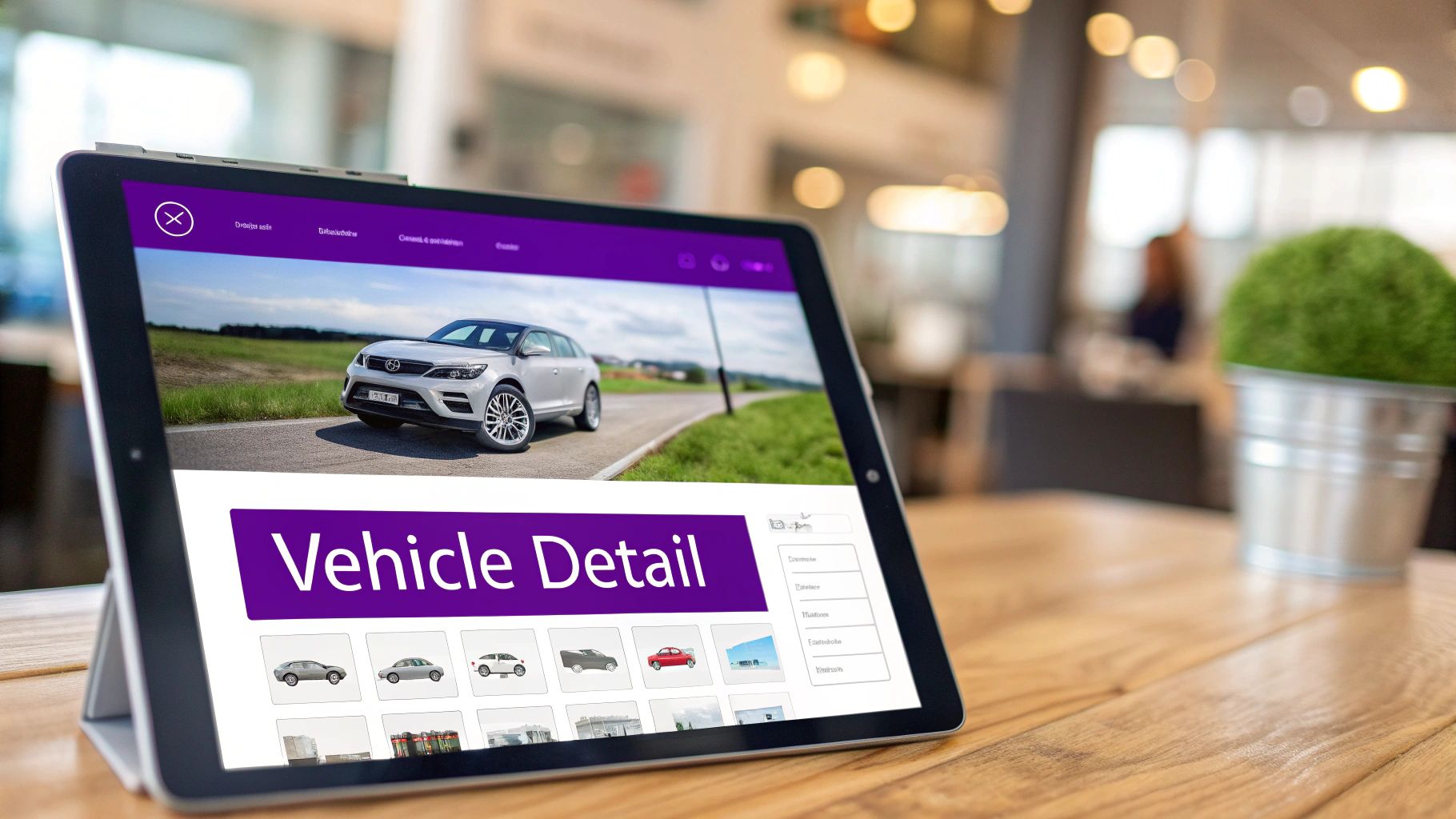
Your Vehicle Detail Pages (VDPs) are your most powerful SEO weapon. Every single one is a chance to rank for a specific make, model, year, and even trim level. The biggest mistake I see dealerships make is using the generic, copy-pasted descriptions provided by the manufacturer. Thousands of other sites have that same text, making it impossible to stand out.
Instead, take a few minutes to write a unique paragraph for each car. Describe its condition, point out a special feature, or suggest who the ideal driver might be. This tells Google your page offers something unique and valuable.
- Title Tags: Don't just list the car. Create a compelling title like:
2021 Toyota RAV4 XLE for Sale in Springfield, IL | Main Street Motors. - Meta Descriptions: Think of this as a tiny ad in the search results. Write something that makes people want to click and see more.
- Image Alt Text: Describe your photos for search engines and visually impaired users. Instead of "IMG_4051," use "2022 Honda CR-V EX-L interior dashboard view."
These small habits, applied consistently across your inventory, build a massive SEO advantage over time.
Tapping Into Schema and Google Vehicle Listings
To really give Google a hand, you need to implement Vehicle schema markup. Think of it as a special code that translates your VDP into a language search engines perfectly understand. It explicitly tells them, "This page is about a specific car for sale."
This is a non-negotiable step in modern automotive SEO. Why? Because proper schema is what makes your inventory eligible for Google Vehicle Listings. This is the feature that puts your cars right at the top of the search results—complete with price, mileage, and your location. It's prime digital real estate that attracts the most motivated buyers.
Schema markup is like giving Google a detailed spec sheet for each car on your website. It removes all guesswork for the search engine, dramatically increasing your chances of appearing in specialized, high-converting search features.
Owning Your Local SEO Footprint
As a local dealership, your physical location is everything. The first thing you absolutely must do is claim and completely fill out your Google Business Profile (GBP). This is your storefront on Google Search and Maps.
Don't skip any sections. Add your services, hours, tons of real photos, and answer customer questions. Proactively ask your happy customers for reviews—that social proof is a huge factor in local rankings. For many people, your GBP is the very first impression they'll have of your dealership. For a deeper look, our guide on local SEO for car dealerships has even more tips.
Beyond GBP, you need to keep your NAP (Name, Address, Phone Number) consistent everywhere online. Make sure the details on your website, social media, and local directories like Yelp are all identical. Even a small inconsistency can confuse Google and hurt your ability to rank locally.
Why Speed Is an Unspoken Ranking Factor
Finally, don't overlook your site's speed. A slow website isn't just frustrating for users; Google actively penalizes slow sites in its rankings. This is especially true in the auto industry where a majority of shoppers are browsing inventory on their phones.
The data is clear: mobile page load times need to be fast. To get there, focus on these fundamentals:
- Image Optimization: Compress your vehicle photos. You need high-quality images, but they can't be massive files that bog down the page.
- Code Minification: This is a technical step to clean up your site’s code, removing unnecessary bits to make the files smaller and faster.
- Quality Hosting: Don't cheap out on hosting. A solid provider can make a world of difference in how quickly your site loads for visitors.
When you combine sharp VDP optimization, technical schema, a strong local presence, and a lightning-fast site, you build a digital showroom that doesn't just look good—it actively goes out and finds new customers for you.
Creating Frictionless Lead Capture Funnels
Every single part of your website—from the homepage hero image to the last photo on a vehicle detail page—should be working to turn a casual browser into a solid lead. A beautiful site that doesn’t generate leads is really just an expensive online brochure. The secret to building conversion funnels that actually work is making it feel effortless, intuitive, and genuinely helpful for a shopper to get in touch.
It all starts with recognizing that not all leads are created equal. A customer who's just starting to explore monthly payments is in a totally different headspace than someone ready to book a test drive tomorrow. Your site has to cater to both, and everyone in between, with a smart mix of lead capture tools.
Designing Forms That People Actually Finish
We've all seen them: the classic dealership contact form. It’s a staple, but it's also where a staggering number of leads go to die. The biggest killer is friction—asking for way too much information, way too soon.
Think about it: every extra field you add is another reason for someone to give up and leave. To fight this, keep your initial forms almost ridiculously simple. For a "Check Availability" request, what do you really need? A name, email, and maybe a phone number. That's it. You can get the rest of the details later. Your first goal is just to open the door to a conversation, not to run a full credit check.
The golden rule for forms is simple: only ask for what you absolutely need to take the next step. If that next step is a phone call, you don't need their life story. Respecting a user's time is the first move in building trust.
Also, give them a clear reason why they should fill out the form. Ditch the generic "Submit" button. Use specific, action-oriented text that tells the user exactly what they're getting. Buttons like "Get My ePrice," "Send Me a Video Walk-Around," or "Confirm Availability" make the value exchange crystal clear.
Placing Your Calls to Action Where They Count
Your most important calls-to-action (CTAs) should never be more than a quick scroll away. On your Vehicle Detail Pages (VDPs), this means putting big, bold buttons right up top near the price, and then repeating them further down the page after the specs and photos. This way, the moment a shopper’s interest peaks, their next step is staring them right in the face.
And don't just stick to static buttons. A "sticky" CTA bar that stays fixed at the top or bottom of the screen as the user scrolls can be a game-changer. This little element should feature your most critical actions:
- Schedule Test Drive: For those high-intent buyers ready to come in.
- Get Pre-Approved: A perfect way to capture serious finance leads early in their journey.
- Value My Trade-In: This is an absolute goldmine for generating seller leads.
This constant, but subtle, reminder keeps the path to conversion wide open without being annoying. It’s about being helpful, not pushy.
Meeting Customers on Their Preferred Channels
Today's car shoppers expect to communicate on their terms. Forms and phone calls still have their place, but adding modern channels can seriously boost your lead count simply by making it easier for people to reach out. Lots of folks would rather fire off a quick text or use live chat than wait around for an email reply.
Your website, especially the VDPs, should offer multiple ways to connect:
- Click-to-Call: This is non-negotiable for mobile visitors. A single tap should instantly dial your sales line.
- Live Chat: Great for answering quick questions about features or confirming if a car is still on the lot. This can be staffed by a real person or a well-programmed bot.
- SMS/Texting Options: Let people text you directly from a listing. A simple prompt like, "Text us about this F-150" feels modern and low-pressure.
By offering these different options, you empower customers to use the channel they're most comfortable with. This simple accommodation makes your dealership feel more accessible and customer-focused, turning a hesitant browser into a qualified lead in your CRM before they have a chance to click away.
Integrating The Right Tech For A Seamless Operation
A modern dealership website is so much more than a digital brochure. It should be the central hub that connects your inventory, your sales team, and your customers. Getting the tech stack right isn't just about bolting on features; it's about building a smart, automated system that saves you time and gives buyers a better experience. The right integrations are what turn a static website into a powerful business tool that works for you around the clock.

This interconnected system is what makes data flow smoothly from the lot to your listings to your lead management software, killing double-entry and cutting down on costly mistakes.
Sync Your Inventory In Real Time
Let's be honest, manually updating your online inventory is a nightmare. It's frustrating for you and even more so for your customers. Nothing kills a potential sale faster than a buyer calling about a car that you sold three days ago. This is exactly why a direct integration with your Inventory Management System (IMS) or Dealer Management System (DMS) is non-negotiable.
This connection puts the entire process on autopilot. When you add a new vehicle to your system or mark one as sold, an automated data feed instantly updates your website. This ensures your online showroom is always a perfect mirror of your physical lot, providing the kind of accuracy that builds trust with buyers.
Enrich Listings Instantly With a VIN Decoder
Creating detailed, accurate vehicle listings takes an incredible amount of time. A VIN decoder integration is a simple tool that delivers a huge return by automating this whole chunk of work.
Just punch in the Vehicle Identification Number (VIN), and the decoder automatically pulls and populates a ton of information directly into your listing fields. This usually includes:
- Core Details: Year, make, model, trim, and engine specs.
- Factory Features: A full rundown of standard and optional equipment.
- Technical Data: Things like fuel economy, transmission type, and drivetrain.
Not only does this save hours upon hours of manual data entry, but it also dramatically reduces the risk of human error. The result? Richer, more accurate, and more trustworthy Vehicle Detail Pages (VDPs) that you can create in a fraction of the time. This is why it’s a standard feature on platforms like AutoFire's Pro plan—it’s that essential.
A seamless tech stack is the invisible engine of a great dealership website. It automates the tedious work, enriches the customer experience, and frees your team to focus on what they do best: building relationships and selling cars.
The right tools working in harmony create a system that's far more powerful than the sum of its parts. Let's look at how some of these key integrations directly improve your operations.
Essential Integrations For a Modern Dealership Website
The table below breaks down the key third-party tools that can transform your website's functionality and streamline your day-to-day business.
| Integration Type | Example Tool | Primary Benefit |
|---|---|---|
| Inventory Management | vAuto, HomeNet | Ensures real-time inventory accuracy, eliminating manual updates and preventing outdated listings. |
| VIN Decoder | Integrated Platform Tool | Instantly auto-populates vehicle specs and features, saving time and improving listing accuracy. |
| Analytics Platform | Google Analytics 4 (GA4) | Tracks user behavior, measures VDP views, and identifies which marketing channels are driving leads. |
| CRM System | DealerSocket, VinSolutions | Automatically funnels web leads to your sales team, enabling faster follow-up and better lead tracking. |
| Social Sharing Tools | OpenGraph Protocol | Controls how your vehicle listings appear when shared on social media, creating professional, clickable posts. |
Each of these integrations plays a critical role in turning your site from a simple online presence into an efficient, lead-generating machine.
Measure What Matters With Analytics
You can't improve what you don't measure. Integrating an analytics platform like Google Analytics 4 (GA4) is absolutely essential for understanding how real people interact with your site. It helps you move beyond vanity metrics like raw traffic and gives you real, actionable insights into what's actually working.
With GA4 properly set up, you can track the metrics that directly impact your bottom line. Are visitors spending quality time on your VDPs? Which lead forms are they actually filling out? Where is your most valuable traffic coming from? Answering these questions with hard data allows you to make smart decisions to optimize your site and your marketing budget for much better results.
Your Top Dealership Website Questions, Answered
When you're running an independent dealership, you're juggling a dozen things at once. Building a website that actually brings in customers can feel like a whole other full-time job. Let’s cut through the noise and tackle the questions I hear most often from dealers just like you.
What’s a Realistic Budget for a Professional Car Dealership Website?
This is the big one, and the honest answer is: it depends. The price can swing wildly based on what you need.
For a newer dealership just getting its feet wet, a clean, professional site built on a solid template might only cost a few thousand dollars. But if you’re looking for a fully custom build with all the bells and whistles, you could be looking at a range of $15,000 to $50,000 or more.
So, what does that higher price tag get you?
- Deep Integrations: We’re talking about a seamless connection to your inventory management system.
- Smart Automation: Features like an automatic VIN decoder that populates vehicle details for you.
- Custom Tools: Things like tailored financing calculators and unique lead capture forms that fit your sales process.
Ultimately, the cost comes down to the size of your dealership, how many cars you move, and how much you want the website to do for you automatically. And don't forget to factor in ongoing costs for things like hosting, maintenance, and any SEO work you plan to do.
How Do I Keep My Online Inventory From Becoming a Mess?
Manually updating your inventory online is a recipe for disaster. You sell a car, forget to take it down, and you end up with a frustrated customer who drove down to see a vehicle that’s already gone.
The only real-world solution here is automation. This means integrating your website directly with your Inventory Management System (IMS) or Dealer Management System (DMS). A good developer will set up a data feed that constantly syncs your on-the-lot inventory with your online listings.
When a new car hits your system, it appears on the site. When you mark one as sold, it disappears. It’s that simple. This is non-negotiable for running a professional operation and keeping customers happy.
What Metrics Actually Matter for My Website?
It’s easy to get caught up in vanity metrics like total website visitors. But a spike in traffic doesn't pay the bills. You need to focus on the numbers that show real buyer intent—your Key Performance Indicators (KPIs).
Think about it this way: 100 people who land on your homepage and immediately leave are worthless. Ten people who dig through a few of your Vehicle Detail Pages are interesting. But the one person who fills out a credit app? That’s gold.
These are the KPIs you should be watching like a hawk:
- Lead Form Submissions: How many people are filling out your contact forms, test drive requests, and finance applications? This is your bread and butter.
- Phone Calls from the Website: Use call tracking to know exactly how many calls your site is generating.
- Vehicle Detail Page (VDP) Views: This tells you which cars are hot and how engaged your visitors are with your actual inventory.
- Bounce Rate: If people are leaving your key pages instantly, something is wrong with the design, the message, or the user experience.
- Organic Search Traffic: This is your report card for SEO. Is your site bringing in free, high-intent traffic from Google?
Tracking these numbers gives you an honest look at how your website is performing as a sales tool, not just a digital brochure.
Is a Blog Really Worth the Effort for My Dealership?
Yes, 100%. A blog is one of the single most powerful SEO tools you have. It’s how you stop being just another dealership listing cars and start becoming a trusted local automotive authority.
Think about the questions your customers ask every day. Now, turn those into blog posts. "Best Used SUVs for Families in Austin" or "Tips for Maintaining Your Truck in the Texas Heat." This is the kind of stuff real people are searching for.
This content helps you show up in Google for search terms your competition is completely ignoring. Better yet, it builds trust before a customer even thinks about stepping onto your lot. It also gives you fantastic, high-value content to share on social media, pulling in even more potential buyers.
Ready to launch a professional, lead-generating website without the technical headaches? AutoFire provides a modern, SEO-optimized platform designed specifically for independent dealerships. Get your inventory online in minutes and start competing with larger stores today. Explore what you can build at https://goautofire.com.