 ™
™

Let's be honest. When we talk about "improving website conversion rates," what we really mean is getting more of the people already visiting your site to actually pick up the phone or fill out a form. It’s all about finding and fixing the "leaks" in your digital showroom—those little things like slow pages, a confusing menu, or a terrible mobile layout—that make it hard for a ready buyer to take the next step.
Why Your Dealership Website Is Losing Leads
Does this sound familiar? You're getting traffic to your website, but the phone is silent and the lead forms are empty. It’s a common frustration, and it usually points to a disconnect between attracting visitors and actually convincing them to act.
The hard truth is that many dealership websites, without meaning to, put up roadblocks for potential customers. Think of it like a physical showroom with no clear entrance, cluttered aisles, and not a single salesperson in sight. Someone might wander in, but they’ll turn right back around if they can't figure out where to go. This "digital friction" is what kills your conversion rate.
Understanding the Conversion Gap
The difference between a top-performing dealership and an average one isn’t luck; it's about a smart, customer-focused online strategy. On average, a typical car dealership website converts about 2% of its visitors into leads. However, with the right optimizations, top-performing dealerships can see significantly higher rates. That massive gap shows just how much opportunity is on the table with a well-oiled website.
Not all traffic is created equal, either. Knowing where your most valuable visitors come from is key.
Dealership Website Conversion Rate Benchmarks
| Traffic Channel | Average Conversion Rate |
|---|---|
| Organic Search | 2.5% |
| Paid Search | 2.3% |
| Social Media | 2.9% |
| Referral | 2.4% |
| Direct Traffic | 2.1% |
As you can see, visitors from organic search and social media tend to be more engaged and ready to convert. It's also crucial to track phone calls as a primary conversion, as many visitors prefer to call the dealership directly rather than fill out a form.
The modern car buyer's journey is a mix of online research and in-person visits. With 71% of buyers using multiple channels, your website has to make a killer first impression to even earn you a shot at a showroom visit.
Common Conversion Killers to Address
So, where are these valuable leads slipping through the cracks? The culprits are usually basic issues that add up to a frustrating user experience. Finding them is the first step to turning things around.
Here are the most common problems we see that cause visitors to abandon a dealership website:
- Slow Page Load Speeds: Every extra second it takes for a page to load is another chance for a potential buyer to click away.
- A Terrible Mobile Experience: If your site is a pain to use on a smartphone, you're alienating the majority of your audience. Period.
- Confusing Navigation: Customers leave when they can't easily find your inventory, contact info, or financing application.
- Slow Lead Response Times: One of the biggest reasons dealerships lose leads is slow follow-up. Using tools like text message automations can engage a new lead instantly, before they lose interest and move on to a competitor.
This guide isn't about getting bogged down in technical jargon. It's about making a series of smart, achievable improvements. We'll walk you through how to fix these foundational problems and turn your digital showroom into your most effective salesperson.
Building a Lead Capture Strategy That Actually Works
Alright, you've figured out where leads are dropping off. Now it's time to build a system that actively pulls them in and gets them to take action. The single most powerful tool you have for this is your website's call-to-action (CTA) buttons. Think of them as the digital version of your best salesperson asking, "Ready to get behind the wheel?"
So many dealership websites stumble right here. They fall back on tired, passive CTAs like "Contact Us" or "Learn More." These just don't connect with what a car shopper is actually thinking. A customer on your VDP isn't just "learning more"; they're trying to figure out if this is their next car. Your CTAs have to match that intent.
Picking CTAs That Drive Real-World Action
If you want to genuinely move the needle on conversions, you need to use language that prompts a specific, valuable next step. For someone looking at a car online, what’s the most logical thing to do next? See it in person and make sure it’s still on the lot.
This isn't just a hunch; the data backs it up. In-depth analysis of dealership websites shows a massive gap in lead quality depending on the CTA.
According to a deep-dive from DealerKnows.com, "Test Drive" CTAs might only account for about 1% of a dealer's total leads, but those leads have a 70% higher closing ratio. Even leads from a "Check Availability" button close 45% better than those from a generic quote or payment request.
The takeaway here is simple but powerful: Stop asking for vague interest and start asking for a real commitment. Generic buttons create friction and doubt. Specific actions, like scheduling a test drive, attract serious buyers who are ready to move forward.
This is exactly what a high-impact CTA setup should look like on a Vehicle Detail Page. The next steps are impossible to miss.
See how "Test Drive" and "Check Availability" command all the attention? That's by design.
Putting Your High-Impact CTAs into Play
Rolling this out across your site is pretty straightforward, but consistency is key. Your mission is to make the next step totally obvious and appealing on every single vehicle page.
- Make Them Standard: Every VDP needs a "Schedule Test Drive" and "Check Availability" button. Make them the biggest, boldest things on the page.
- Kill the Generic Language: Get rid of "Submit" or "Send." The button should always tell the user exactly what they're doing, like "Request My Test Drive."
- Position for Impact: Place your main CTAs "above the fold" so they're visible without any scrolling. This is absolutely critical for your mobile visitors.
Speaking of what not to do, let's talk about pop-up forms. The same industry data showed that pop-up CTAs are a conversion nightmare, with closing ratios more than four times worse than other lead types. Just don't use them. They interrupt the shopping experience and feel aggressive, especially on a phone where they can take over the whole screen.
Keep Your Lead Forms Short and Sweet
Once someone clicks that beautiful, high-intent CTA, don't immediately hit them with a 20-question form. Every extra field you ask for is another reason for them to give up and leave. All you really need to do is open the conversation and book the appointment.
An effective lead form only asks for the bare essentials:
- Name: So you know who you're talking to.
- Phone Number: For a quick follow-up call.
- Email Address: As a reliable backup.
That's it. You don't need their life story, trade-in details, or social security number right now. The whole point of the form is to get their contact info so your team can schedule the visit. You can gather all the other details when you talk to them.
Of course, managing that follow-up efficiently is a whole other piece of the puzzle. That's where a good system comes into play. You can see how the right tech helps by checking out our guide on the best CRM for car dealers. When you pair strong CTAs with simple, frictionless forms, you create a lead-gen machine that works for you around the clock.
Optimizing Inventory Pages for Mobile Shoppers
Let's be blunt: if a customer can't easily browse your cars on their phone, you've already lost the sale. The journey to a new car almost always starts on a mobile device these days. This makes your Vehicle Detail Pages (VDPs) the most critical digital real estate you own. Getting this experience right isn't just a nice-to-have; it's the bedrock of converting website traffic into leads.
A clunky, slow-loading mobile VDP is a deal-breaker. Shoppers have zero patience. Every extra second they spend waiting for a blurry photo to load is a second they could be on your competitor's faster, cleaner site. Your mobile inventory pages absolutely must be quick, intuitive, and designed to answer a buyer's biggest questions right away.
Make a Powerful First Impression Above the Fold
The "above the fold" area—what a user sees on their screen without scrolling—is your one shot to grab their attention. On a small mobile screen, this space is incredibly valuable. You have to be ruthless about prioritizing what matters most to keep them from bouncing.
Think about it from their perspective. If a buyer has to scroll and hunt just to find the price, you're creating friction and frustration. A great mobile VDP puts all the essential info right where they can see it.
Here’s what every mobile shopper needs to see the second the page loads:
- A High-Quality Photo Gallery: The first thing anyone wants to see is the car. A big, beautiful, swipeable photo gallery is non-negotiable.
- The Price: Don't make them work for it. Display the price clearly and prominently.
- Key Vehicle Specs: Mileage and VIN are must-haves, visible at a glance.
- Primary CTAs: Those "Schedule Test Drive" and "Check Availability" buttons need to be right there, easy to tap without zooming in.
A mobile user makes a judgment in seconds. Forcing them to hunt for basic information like the price or mileage is one of the fastest ways to lose a potential lead. The goal is to provide answers instantly, not create a digital scavenger hunt.
Create a Visually Engaging Photo Experience
I can't stress this enough: pixelated, poorly lit, or too few photos will kill your conversions faster than anything else. Mobile shoppers want to feel like they're walking around the car, and your photo gallery is the only way to deliver that experience online. It has to be perfect.
Your gallery should feature at least 20-30 high-resolution images that cover every conceivable angle. Get detailed shots of the interior, the dashboard, the engine, and even close-ups of the tire treads. The gallery itself needs to be "touch-friendly," so users can easily swipe through pictures without accidentally clicking on something else. We've got more tips on this in our guide on how to optimize images for your website.
Build Trust with Transparency and Details
Once you've hooked them with great photos and the key stats, it's time to build their confidence. A serious buyer is going to dig into the details to make sure they're making a good decision. Making this information easy to find and digest keeps them on your site and builds the trust you need to get them in the door.
Make sure these trust-building elements are on every VDP:
- A Detailed Description: Go beyond the generic factory specs. Write a short, compelling summary that points out the vehicle's best features, its condition, and what makes it special. Using bullet points is a great way to make this scannable.
- Built-in VIN Decoder: When your site automatically populates vehicle features from the VIN, it not only saves you time but also shows the buyer you're providing accurate, factory-level data.
- Vehicle History Report Integration: Offering a direct link to a CARFAX or AutoCheck report is a huge trust signal. It tells buyers you have nothing to hide and is an absolute must-have for any dealership serious about selling cars online.
When you combine a fast, intuitive mobile layout with rich, trustworthy details, you create a VDP that doesn't just look good—it works hard to turn casual browsers into real appointments.
From Website Lead to Showroom Appointment
Getting a lead form submission is a great start, but let's be honest—it's not the goal. The real win, the conversion that actually pays the bills, is turning that digital interest into a real person walking through your showroom doors.
This is where your online efforts meet your physical dealership, and it’s where a huge number of potential sales are won or lost. The deciding factor? Speed.
Your lead response time is everything. A lead is never hotter than in the first few moments after they hit "submit." Their interest is at its peak, they’re actively thinking about that specific car, and they are almost certainly still online. Every minute you wait, that interest cools down, and the odds they’ve already clicked over to your competitor's site go up dramatically.
The Five-Minute Rule for Closing the Loop
So, how fast is fast enough? The data is crystal clear: you have to respond in under five minutes. Waiting just a little longer can tank your chances of ever setting an appointment. A quick, decisive follow-up interrupts their browsing, grabs their full attention, and instantly positions you as a professional, responsive dealership that’s ready to do business.
To understand the impact, it helps to see the entire journey from click to sale. Here’s a look at some industry benchmarks for how a typical used vehicle internet lead moves through the funnel.
| Used Vehicle Internet Lead Conversion Funnel |
| :--- | :--- |
| Funnel Stage | Benchmark Rate |
| Contact Rate | 64% |
| Appointment Set Rate (of contacted) | 41% |
| Appointment Show Rate | 50% |
| Closing Rate (of shown) | 40% |
These numbers tell a powerful story. On average, only about half of the appointments you set will actually show up. The data also suggests that a faster response time directly improves the chances of setting that appointment. For a deeper dive, check out this insightful automotive industry data study.
The second a lead hits your CRM, the clock is ticking. Remember, your primary objective isn't to sell the car over the phone or via text. It’s to sell the appointment. Everything you say and do in that first contact should be laser-focused on one thing: getting them to agree to a specific day and time for a test drive.
This simple flow shows how a well-optimized mobile VDP moves a shopper from just looking to becoming a lead you can call.
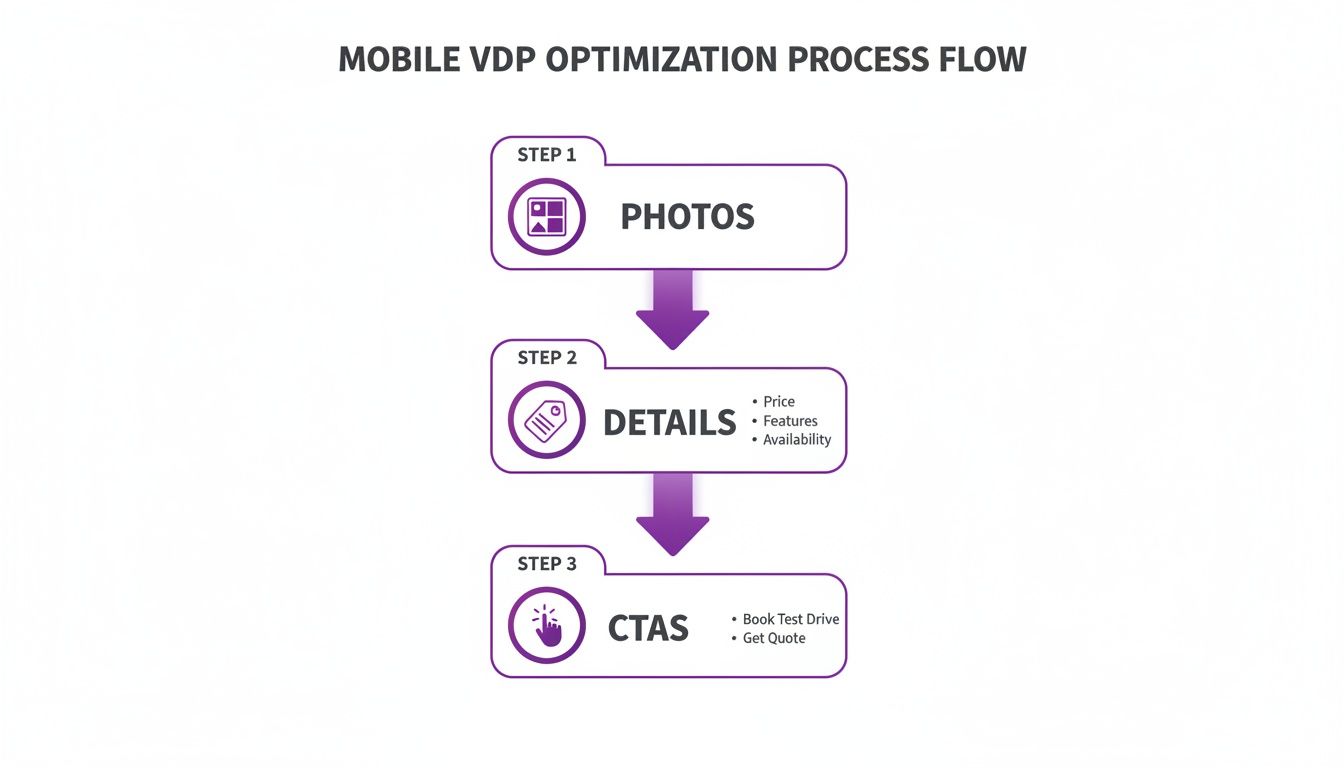
The path is direct: engaging photos and clear details lead straight to the call-to-action buttons that generate the lead in the first place. Your quick follow-up is the final, crucial step in that journey.
Crafting the Perfect First Contact
So, what do you actually say in that critical first phone call or text? Keep it simple, direct, and focused on what the customer wants. Your script doesn't need to be fancy, but it has to accomplish a few key things right away.
Here’s a practical game plan for that initial outreach:
- Confirm Vehicle Availability: Lead with the good news. Immediately confirm the vehicle they asked about is still on the lot. This builds instant trust and answers their most important question.
- Pivot Straight to the Test Drive: Don't hesitate. The second you've confirmed availability, pivot to setting the appointment. A great line is, "It's available. When would be a good time for you to come in and take it for a drive?"
- Offer Two Specific Times: Avoid vague questions like "When can you come in?" That puts the work on them. Instead, guide the conversation with two concrete options: "I have an opening at 4:30 PM today or 10:00 AM tomorrow. Which of those works better for you?"
- Lock It In: Once they've picked a time, then you can confirm their full name and any other details you need to log the appointment in your system.
This approach transforms the conversation from a passive inquiry into an active, productive appointment-setting machine. By taking control and guiding them to the next logical step, you dramatically increase the chances they'll actually show up.
Knowing how to improve website conversion rates goes way beyond your site's design—it plugs directly into your sales process. Nailing your lead response is one of the highest-impact, lowest-cost strategies you can implement. It’s all about creating a seamless bridge from their screen to your showroom, making sure no motivated buyer slips through the cracks.
Driving High-Intent Traffic with Local SEO
Having a website that converts is great, but it’s only half the story. You have to get the right people to that site in the first place—I'm talking about motivated, local buyers who are deep in their search for their next vehicle. This is exactly where local Search Engine Optimization (SEO) becomes your dealership's secret weapon for generating serious, high-intent leads.
Local SEO is how you show up for those money-making "near me" searches. Think "used F-150s for sale near me" or "Honda CR-V in Springfield." It’s all about making your dealership impossible to miss the moment a local customer is ready to buy. This lets you go toe-to-toe with the big franchise stores, often without a massive ad budget.
Your Google Business Profile Is Your Digital Front Door
Long before a car shopper ever lands on your website, their first impression of your dealership is probably your Google Business Profile (GBP). You know the one—it's that info box that pops up in Google Maps and on the side of the search results. I tell dealers to think of it as their digital storefront. If the lights are off or the sign is spelled wrong, customers will just keep scrolling.
Getting your GBP dialed in isn't optional; it's the absolute first step. It’s a free tool that has a direct line to how customers find you and, more importantly, what they think of you.
Here’s how to turn it into a lead-generating machine:
- Fill Out Everything. Don’t skip a single field. Business hours, address, phone number, website link—make sure it's all there and 100% accurate.
- Use Great Photos. Show off your best-looking inventory, your clean lot, and your smiling team. Help people picture themselves buying a car from you.
- Make Reviews a Priority. Positive reviews are gold in local search. Make it a habit to ask every happy customer to leave a review on Google. It’s one of the strongest trust signals you can build.
A well-tended Google Business Profile does so much more than just list your hours. It builds instant credibility. When a local buyer sees a complete profile packed with positive reviews and current photos, it tells them you’re a professional, trustworthy place to do business.
Turn Customer Reviews into a Conversion Asset
Speaking of reviews, they've completely replaced old-school word-of-mouth. Research from Northwestern University found that just showing reviews can boost conversion rates by an incredible 270%. They give hesitant shoppers the social proof they need to feel good about visiting your lot.
But just having reviews isn't the whole game—you need to actively manage them. Taking the time to respond to every single one, good or bad, shows you care about the customer experience. A thoughtful reply to a negative review can often defuse the situation and shows other potential buyers how you handle business when things don't go perfectly.
Get Your Inventory on Google Vehicle Listings
For independent dealers, Google Vehicle Listings is a game-changer. This feature puts your actual cars directly into the Google search results when someone is looking for a specific make and model. This isn't just a link; it's a photo of the car, the price, the mileage, and your dealership's name, often appearing above the regular organic search results.
This is a powerful way to pull high-intent traffic straight to your Vehicle Detail Pages (VDPs), where the conversions happen. For any dealership looking to compete today, getting your inventory feed connected is a must-do. You can get a much deeper look into this strategy in our guide on local SEO for car dealerships.
The Technical Foundation of Good SEO
Finally, remember that all of these efforts are built on a solid technical foundation. Google wants to send its users to websites that work well, and that really boils down to three core things:
- Site Speed: A slow website kills conversions. Google knows this and rewards sites that load in a snap.
- Mobile-Friendliness: Most car shopping starts on a phone. Your site has to look and work perfectly on a small screen.
- Security (HTTPS): A secure site (one with the little padlock icon) protects your customers' data and is a basic requirement for ranking well.
At the end of the day, driving high-intent traffic isn't about some secret trick. It's about making it ridiculously easy for local car buyers to find you and your vehicles online. By mastering your GBP, championing customer reviews, and getting your cars into Google Vehicle Listings, you build an organic marketing engine that brings ready-to-buy shoppers right to your digital front door.
Dealership Website Conversion FAQs
Jumping into digital marketing can feel like you're drinking from a firehose, but a few core ideas can make a huge impact. Here, I'm going to tackle the most common questions I hear from independent dealers about turning website clicks into showroom handshakes. These are straightforward answers you can put to work right away.
What Is a Good Conversion Rate for a Car Dealership Website?
Look, the industry benchmark is around 2%, but getting fixated on an average is a mistake. A truly "good" conversion rate is one that’s always getting better. Your real goal should be to consistently beat your own numbers, month after month. It's possible for highly optimized dealerships to achieve significantly higher conversion rates with a focused strategy.
The secret isn’t just your website—it’s the quality of traffic hitting it. For instance, people coming from organic search typically convert at a higher rate, around 2.5%, because they're motivated, local buyers actively looking for a car. The foundation for hitting those higher numbers is a fast, mobile-friendly site that makes it dead simple for a visitor to take that next valuable step.
How Can I Track My Website Conversions Accurately?
You can't improve what you don't measure. For a dealership, this really boils down to two critical actions: lead form submissions and phone calls that come directly from your website. Guesswork won't tell you how to improve website conversion rates; only hard data can.
Tracking form submissions for test drives or availability checks is pretty easy—you just need to set up "Goals" inside Google Analytics. Every time a form is filled out, a conversion gets logged. Simple. For phone calls, the best method by far is to use a unique, trackable phone number specifically for your website. This is how you connect the dots between your online activity and offline leads, showing you exactly which pages and vehicles are making the phone ring.
Proper tracking takes the emotion and guesswork out of your marketing. It lets you make decisions based on data, so you can double down on what works and fix what doesn't. That’s the entire game when it comes to effective conversion rate optimization.
What Is the Single Biggest Change I Can Make to Increase Conversions?
If you only do one thing after reading this guide, fix your Call-to-Action (CTA) buttons. Seriously. This is the lowest-hanging fruit with the biggest potential payoff. Go through your vehicle detail pages (VDPs) and get rid of vague, wimpy CTAs like "Learn More" or "Submit." They don't inspire action.
Instead, switch to powerful, high-intent CTAs like "Schedule a Test Drive" and "Check Availability." The data on this is crystal clear: leads that come from a "Test Drive" button have a 70% higher closing ratio than other lead types. This one small tweak aligns your website with what a serious car buyer actually wants to do next—get behind the wheel.
Do I Need a Huge Budget for Conversion Rate Optimization?
Absolutely not. That’s one of the biggest myths out there. Many of the most powerful strategies for boosting your dealership’s conversions cost you nothing but a bit of your time and attention. For a deeper dive into improving your site's performance, this Website Conversion Rate Optimisation: A Practical Guide offers some great insights.
Here are a few high-impact, zero-cost improvements you can make today:
- Sharpen your CTAs like we just talked about.
- Write better vehicle descriptions that are more compelling and detailed.
- Make sure your vehicle photos are high-quality and show every possible angle.
- Commit to responding to every single lead in under five minutes. Speed kills the competition.
These actions don't require a big checkbook, but they do require focus. A solid website platform should handle the technical heavy lifting—like site speed, security, and mobile design—which frees you up to concentrate on these simple yet powerful optimizations that lead directly to more appointments and sales.
Ready to stop losing leads and start turning your website traffic into actual sales? AutoFire™ provides a fast, modern, and SEO-optimized website built from the ground up for independent dealers. Get your inventory online in minutes and start capturing high-intent buyers today.
