
Think of an auto dealer website builder as a specialized software platform, built from the ground up to create and run websites for car dealerships. These aren't your average website tools; they come packed with everything a dealer needs, like automatic inventory updates, VIN decoding, and lead capture forms designed specifically for selling cars.
Why Generic Builders Don't Work for Car Dealerships
Trying to run a dealership website on a generic platform like Wix or Squarespace is a bit like showing up to a Formula 1 race in a family sedan. Sure, it gets you on the track, but you're not equipped to compete, let alone win. A car dealership isn't just a simple online store—it's a complex, inventory-heavy operation that needs a purpose-built digital showroom.
Generic builders are fantastic for artists, bloggers, or small shops selling t-shirts. They're just not built to handle the unique data and fast-paced nature of automotive retail. Their "add product" model simply can't cope with the dozens of data points tied to every single vehicle.
It's the difference between seeing a family doctor and a heart surgeon. For a complex, critical procedure, you want the specialist. An auto dealer website builder is that specialist, armed with the precise tools to drive your business forward.

The Critical Gaps in General-Purpose Tools
When you use a generic builder, you quickly run into roadblocks. You’re forced to patch things together with clunky workarounds or expensive custom coding that inevitably breaks. The foundational pieces just aren't there.
Here’s what’s missing:
- No Automated VIN Decoding: Imagine manually typing in the specs, options, and history for every car. It’s a massive time-sink and a recipe for mistakes.
- Lack of DMS Integration: There's no clean way to sync your website with your Dealer Management System (DMS). This means your online inventory is constantly out of date, leading to frustrated shoppers calling about sold vehicles.
- Generic Lead Forms: A basic "Contact Us" form doesn't cut it. You need forms that capture which car a buyer is interested in, gather trade-in details, and pre-qualify them for financing.
A general-purpose builder gives you a nice-looking shell, but it's empty inside. It’s missing the engine required to manage real-time inventory, syndicate listings, and create sales funnels that actually convert.
Why Specialization Is a Necessity
Let's face it, the modern car buying journey begins online. The vast majority of today's car shoppers use digital tools for their research, checking out multiple websites before they ever step onto a lot. A huge chunk of that research happens on a smartphone, so a mobile-first website isn't a luxury—it's table stakes.
A specialized builder helps plug major leaks in your sales process. When leads are mishandled or never make it into a CRM, potential sales can be lost. Seamless website funnels are designed to solve exactly that problem. You can dive deeper into these automotive trends in research from Spyne.ai.
A specialized auto dealer website builder is engineered from day one to manage inventory, engage buyers, and turn website traffic into real, qualified leads. It ensures your digital showroom works just as hard as your best salesperson.
What Really Matters: The Must-Have Features for Your Dealership Website
When you're picking an auto dealer website builder, it's easy to get distracted by flashy designs. But the real power isn't in the paint job; it's under the hood. A great dealership website is more than an online brochure—it's an automated sales machine, and the features that drive it are non-negotiable if you want to compete.
Think of it like this: anyone can weld a car frame together, but it's the engine, transmission, and all the wiring that actually make it go. The core features of a specialized website builder are what turn a static page into a genuine lead-generating powerhouse. These are the tools that do the heavy lifting, freeing you up to focus on what you do best: selling cars.
These essentials all work in harmony to pull in local buyers, give them the details they’re looking for, and make it dead simple for them to take the next step.
Automated Inventory Management and DMS Sync
We’ve all seen it happen. A customer finds the perfect car on your site, calls in all excited, only to hear, "Sorry, that one sold yesterday." That single moment doesn't just lose a sale; it kills trust and sends a hot lead right down the street to your competitor. Trying to manage inventory by hand is just asking for this to happen.
A top-tier auto dealer website builder puts an end to this nightmare with automated inventory management. This feature creates a direct, live connection between your physical lot and your digital showroom.
It works by plugging directly into your Dealer Management System (DMS). The second a vehicle is added to your system or marked as sold, your website reflects that change instantly. This real-time sync guarantees your online inventory is always accurate. No more disappointed customers, and no more wasted hours for your team on manual data entry.
Automatic VIN Decoding for Rich VDPs
A car’s Vehicle Identification Number (VIN) isn't just a string of characters; it's the vehicle's DNA. It holds everything from the engine and trim to all the factory-installed options. Typing all that information in by hand for every single car is not only painfully slow but also an open invitation for mistakes.
This is where automatic VIN decoding completely changes the game. You plug in the VIN, and the platform instantly builds out a detailed and accurate Vehicle Detail Page (VDP).
A powerful VIN decoder takes a simple stock number and turns it into a rich, engaging VDP packed with high-res photos, detailed specs, and a compelling vehicle history. This automation builds buyer confidence and keeps them glued to your site.
This one feature creates all the content a shopper needs to feel confident, transforming a basic listing into a serious research tool that keeps them on your website longer.
Mobile-First Design for On-the-Go Shoppers
Let's face it, most of the car buying journey now happens on a smartphone—during a lunch break, in a waiting room, or on the couch. If your website is a clunky, hard-to-use mess on a small screen, you're actively turning away customers. A "mobile-friendly" site just doesn't cut it anymore; you need a mobile-first design.
This approach means your site was designed for the phone from the very beginning, not squished down as an afterthought. Every button, every photo, and every form is built for touchscreens and smaller displays. It guarantees a smooth, easy experience for every visitor, which is absolutely critical for turning that traffic into actual leads.
Built-In Local SEO Tools
Showing up on the first page of Google when someone in your town searches for "used trucks near me" is pure gold. Generic website builders might give you some basic SEO settings, but they know nothing about the auto business.
A purpose-built platform for dealers comes with built-in SEO tools that are wired for one thing: selling cars locally. This includes things like:
- Automated Schema Markup: This is special code that tells search engines your listings are vehicles, helping you show up in special results like Google Vehicle Listings.
- Optimized VDPs: Your vehicle pages are automatically structured to rank for specific searches like "used Ford F-150 in Anytown."
- Local SEO Focus: The entire site is built to signal to Google that you are the authority for used cars in your city.
These tools are essential for making sure local buyers find you before they find anyone else. To see how all these pieces fit together, you can learn more about the complete feature set of a modern dealership platform.
To put it all in perspective, let's break down the difference between a tool built for dealers and a generic, one-size-fits-all website builder.
Essential vs. Generic Website Builder Features
| Feature | Auto Dealer Website Builder | Generic Website Builder |
|---|---|---|
| Inventory Management | ✅ Real-time DMS sync; updates automatically. | ❌ Manual product entry; prone to errors. |
| VIN Decoding | ✅ Instantly populates vehicle specs and options. | ❌ Not available; requires manual data input. |
| Lead Forms | ✅ Optimized for credit apps & trade-in valuations. | ❌ Basic contact forms only. |
| Local SEO | ✅ Automotive schema markup and location-focused tools. | ❌ General SEO settings; lacks industry context. |
| Mobile Design | ✅ Mobile-first; designed for the car shopping journey. | ❌ Mobile-responsive; often a scaled-down desktop site. |
| Integrations | ✅ Connects with DMS, CRM, and marketing tools. | ❌ Limited, non-automotive integrations. |
As you can see, the right tool isn't just about having a website—it's about having a sales engine that understands the unique demands of running a dealership.
How to Turn Your Website Into a Sales Engine
A great dealership website is more than just an online showroom; it's your best salesperson, working 24/7 to turn casual browsers into serious buyers. It shouldn't just sit there looking pretty—it needs to actively pull customers in and guide them toward a sale. This is where smart integrations come in, connecting your site to the tools that actually run your business.
Think of it this way: these tools aren't just fancy add-ons. They build a bridge between a customer's online research and their visit to your lot. When everything works together, your website becomes the command center for your entire sales process, making sure no lead ever gets lost.
Seamless CRM Integration for Flawless Follow-Up
Every time a customer fills out a form on your site—a test drive request, a trade-in quote, a credit application—that's a hot lead. But if those leads just land in a cluttered email inbox, they'll go cold fast. That's why Customer Relationship Management (CRM) integration is non-negotiable.
Instead of manually entering data, a direct link to your CRM automatically logs every lead, assigns it to the right person, and even sets a reminder for follow-up. This simple automation gets rid of human error and ensures a speedy response, which is exactly what today's buyers expect. Your team gets everything they need to start a real conversation the moment the lead comes in.
Expanding Your Reach with Inventory Syndication
Your website might be your home turf, but your customers are everywhere else—on sites like CarGurus, Autotrader, and Cars.com. Manually posting your cars on each of those platforms is a nightmare of a task, full of tedious data entry and potential mistakes. Inventory syndication makes that whole problem disappear.
With this feature, your auto dealer website builder acts as a central hub. It automatically pushes your inventory—photos, pricing, descriptions, and all—out to dozens of third-party marketplaces.
The best part? When you sell a car or change a price on your site, that update instantly goes out everywhere. You multiply your visibility and put your vehicles in front of millions of shoppers without lifting an extra finger.
This diagram shows how these core website features—inventory, VIN decoding, and SEO—all work together.
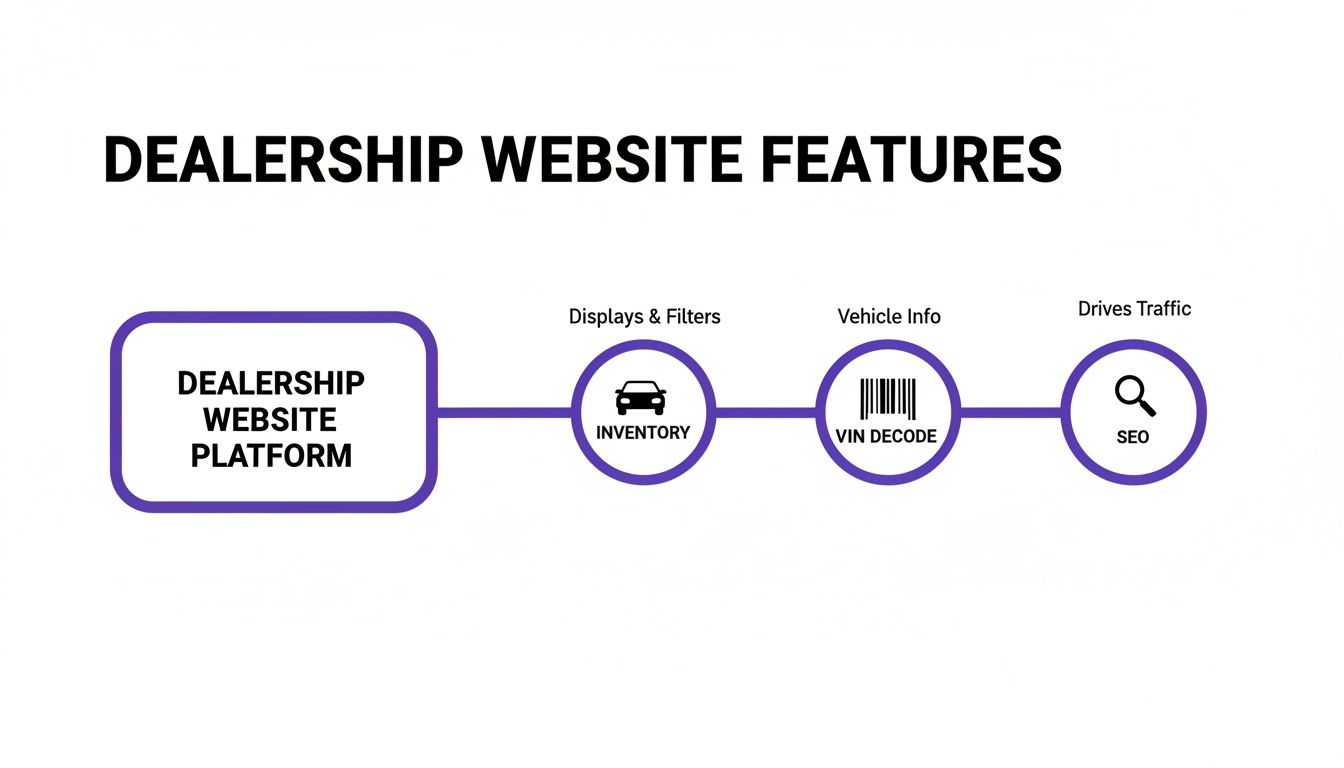
As you can see, having accurate inventory data is the foundation for everything else, from getting found on Google to generating real leads.
Engaging Customers with Interactive Tools
Nobody makes a big purchase after just passively scrolling. To really get a customer invested, you need to give them things to do on your website—tools that help them take the next step in their buying journey.
Here are a few must-have interactive tools:
- Online Finance Applications: Let motivated buyers get the ball rolling on financing right from your vehicle detail page. It saves everyone time and instantly flags customers who are ready to make a deal.
- Trade-In Value Calculators: "What's my car worth?" is one of the first questions on a buyer's mind. Offering an instant trade-in estimate is a killer lead magnet that gives them valuable info in exchange for their contact details.
- AI-Powered Chatbots: A good chatbot can handle common questions, book test drives, and capture lead info long after your team has gone home. It's like having a receptionist on duty around the clock.
By plugging in tools like these, you stop having a static online brochure and start running an interactive sales funnel. Each feature is designed to capture a different kind of lead and move them down the path, turning your website into your hardest-working employee.
Your Checklist for Choosing the Right Platform
Choosing an auto dealer website builder feels a lot like picking a car off a crowded lot. On the surface, they all look shiny and promising, but the real difference is under the hood. To make the right call, you need a solid checklist to cut through the sales pitches and get to what really matters.
Think of this as your pre-purchase inspection. Each point is designed to help you pop the hood on a potential platform and check its engine, transmission, and electronics. This ensures you're investing in a tool that will actually drive your dealership forward, not leave you stranded.
Let's get into the essentials.
Technical Power and Performance
The technical guts of your website are completely invisible to your customers, but they feel the effects on every single click. A slow, glitchy, or insecure site is the digital equivalent of a "check engine" light—it sends buyers running for the exit.
Here’s what to look for:
- Hosting Quality: Does the provider manage the hosting for you? You're a car dealer, not a server admin. A good platform handles all the technical heavy lifting—maintenance, security, and backups—so you can focus on selling cars.
- Site Speed: Don't just take their word for it. Ask for real-world performance data or examples. A site that loads in a flash is non-negotiable for keeping visitors engaged and staying on Google's good side.
- Security: An SSL certificate (the "s" in https://) should be standard, no questions asked. This encrypts customer data, protects their privacy, and shows them your dealership is trustworthy.
User Experience and Ease of Use
The most powerful features are worthless if your team needs a computer science degree to use them. The platform’s backend, or Content Management System (CMS), has to be intuitive. You should be able to add a new car, update a price, or post a special offer without calling for tech support.
A simple test: Could someone on your sales team add a new vehicle to the site, complete with photos and a description, in less than five minutes? If the answer is no, the system will become a major headache.
The best way to know for sure is to get behind the wheel. Ask for a live demo or a trial account. See for yourself how easy it is to manage your digital showroom. To get a feel for what a modern, user-friendly system looks like, you can schedule a demo of the AutoFire platform and take it for a spin.
Marketing Muscle and SEO
Your website isn't just a digital business card; it's your #1 marketing tool. It needs to be a magnet for local car buyers. A website builder designed for dealers should come packed with tools built specifically to get you found online.
Key marketing features include:
- Local SEO Tools: The entire system should be engineered to help you rank for money-making search terms like "used trucks in [Your Town]."
- Schema Markup: This is a big one. It's a special type of code that tells Google, "Hey, this is a vehicle listing!" This helps your inventory show up in more prominent, vehicle-specific search results.
- Blog Integration: A built-in blog is your secret weapon for content marketing. It lets you write articles that answer customer questions, attract local search traffic, and position you as the go-to expert in your area.
Integration and Pricing Transparency
Finally, your website can't operate on an island. It has to talk to the other systems you rely on every day. It also needs to come with a price tag that doesn't have a bunch of surprises buried in the fine print.
- Critical Integrations: Before you sign anything, confirm the platform syncs with your Dealer Management System (DMS) and any CRM software you use. This automation is absolutely fundamental for keeping your inventory and leads up to date without manual work.
- Pricing Structure: Look past the monthly subscription fee. Are there hefty setup costs? Hidden fees for "premium" features? Will you be locked into a long-term contract? A trustworthy partner lays all the costs out on the table from day one.
The online car sales market is exploding, with projections showing significant growth in the coming years. With that kind of market shift, a high-performance website isn't just a nice-to-have—it's an absolute necessity for staying competitive. You can discover more insights about online auto industry growth and see just how big the opportunity is.
Picking the right auto dealer website builder is a big win, but it's just the start. The actual launch can seem daunting, but breaking it down into a clear plan turns a massive project into a series of simple, manageable tasks. A great launch isn’t about speed; it's about being meticulous so your new digital showroom works flawlessly from the moment it goes live.
Think of it like prepping a car for a big auto show. You wouldn’t just give it a quick wash and push it onto the floor. You'd detail every inch, polish the chrome, and double-check the engine to make sure it purrs on the first try. Your website launch needs that same level of care to make a killer first impression.

Your Pre-Launch Preparation Checklist
Before you even think about flipping the switch, you need to get all your assets in order. This groundwork is what gives your site substance, ensuring it has everything needed to connect with customers and properly represent your dealership. Trying to rush this part almost always leads to a messy, unprofessional site and frustrating delays.
Here’s what you absolutely need to have ready to go:
- Your Dealership's Story: This is your chance to write a compelling "About Us" page. People buy from people, so share your history, what you stand for, and what sets you apart from the dealership down the street.
- High-Quality Photos: Get professional headshots of your team and some crisp, inviting photos of your dealership. This builds immediate trust and puts a human face to your name.
- Essential Business Information: It sounds basic, but you’d be surprised how often it's wrong. Triple-check that your address, phone number, and hours are correct and ready to be placed front and center.
A classic launch-day nightmare is realizing your inventory feed isn’t hooked up right. Test the connection to your Dealer Management System (DMS) long before the go-live date to make sure every single vehicle shows up online exactly as it should.
Protecting Your SEO and Migrating Data
One of the biggest fears when launching a new site is watching your hard-earned search rankings vanish. If Google suddenly can't find your old pages, your traffic can tank overnight. That's why a smart migration strategy is non-negotiable.
The absolute key here is implementing 301 redirects. This is a simple but incredibly powerful step that basically tells search engines, "Hey, this old page you liked? It has permanently moved over here." Think of it as setting up mail forwarding for your website. It ensures all your SEO authority transfers cleanly to the new platform, and any decent auto dealer website builder will make this process easy.
The Final Go-Live and Post-Launch Review
If you've done your prep work and planned the migration, the actual go-live day should be pretty drama-free. But your job isn't done just because the site is public. A thorough post-launch check is your last line of defense to catch small glitches before they become major headaches for your customers.
Your Post-Launch Inspection:
- Test Every Form: Fill out every single lead form on the site—credit apps, trade-in valuations, test drive requests. Make sure they not only work but also that the leads are actually getting to your team.
- Check on Mobile: Pull out your phone and act like a customer. Browse your inventory, click through photos, and tap every button in the navigation. The mobile experience has to be perfect.
- Verify Inventory Sync: Add a new car to your DMS and see how quickly it pops up on the website. Then, mark a vehicle as sold and confirm it disappears just as fast.
- Review Key Pages: Give your "About Us" and contact pages one final read-through to spot any last-minute typos or wonky formatting.
Launching a new website is a team sport. If you hit a snag or just have questions along the way, having a reliable support team to call on is crucial. For any questions about making the switch, you can always get in touch with our team for guidance.
Common Mistakes to Avoid After You Go Live
Getting your new website live is a huge step, but it’s really just the starting line. The real work starts now—the day-to-day effort of turning that shiny new site into a machine that consistently brings in leads and closes deals. Too often, a dealership will invest time and money into a great new website, only to let it sit and gather dust, losing all the momentum from the launch.
Think of your website like a brand-new car you just put on the front line of your lot. You wouldn't just park it there and assume it’ll sell itself, right? It needs to be washed, detailed, and prepped to look its best. Your new site, even one built with a powerful auto dealer website builder, needs that same kind of regular attention to give you the best possible return on your investment.
Neglecting Your Visual Merchandising
Want to turn a potential buyer off in seconds? Show them bad pictures. Your vehicle photos are the single most important part of your Vehicle Detail Pages (VDPs). If they're dark, blurry, or look like they were taken on a flip phone in 2005, your inventory—and by extension, your entire dealership—comes across as unprofessional.
Your online showroom deserves the same care as your physical one. Make sure every car is clean and photographed professionally from all the key angles, inside and out. Crisp, high-quality images build trust and are often the final push a customer needs to book that test drive.
Letting Hot Leads Go Cold
When a lead form comes in from your website, that's a customer raising their hand, ready to talk business. And yet, one of the biggest (and most expensive) mistakes dealers make is responding too slowly. Every minute that ticks by after someone hits "submit" is another opportunity for them to click over to a competitor who gets back to them faster.
The goal shouldn't be to respond in a few hours—it should be minutes. A quick, helpful reply tells a customer you value their time and you're serious about winning their business.
Get instant notifications set up for your sales team and make sure everyone knows exactly who is responsible for grabbing online leads. A fast follow-up process is a simple tactic that directly leads to more appointments set and more cars sold.
Ignoring Your Local SEO and Content
Your new website is a powerful tool for grabbing the attention of local car shoppers on Google, but it doesn't work on autopilot. A huge missed opportunity for many dealers is launching a site and then never touching the blog or content tools again.
Publishing fresh content that answers the real questions your customers are asking is essential for local SEO. You could easily write articles about things like:
- Vehicle Comparisons: Put two of your most popular models head-to-head.
- Financing Guides: Offer helpful tips for first-time buyers in your town.
- Maintenance Advice: Share simple "how-to" posts that establish you as the local authority.
This is exactly the kind of stuff that helps you show up for valuable local searches, pulling in customers who are deep in the research phase of their car-buying journey.
Overlooking Your Website Analytics
Your auto dealer website builder comes packed with a goldmine of data showing you exactly how people use your site. Flying blind by ignoring these analytics is a recipe for failure. You absolutely need to know which cars are getting the most VDP views, where your visitors are coming from, and what pages are making them hit the "back" button.
Make it a habit to pop into your analytics dashboard. Are shoppers spending tons of time looking at your truck inventory? Maybe it's time for a truck promotion. Is your "Apply for Financing" page getting a lot of clicks but very few submissions? The form might be too long or confusing. This data gives you the hard facts you need to constantly tweak your strategy and improve your results.
Frequently Asked Questions
When you're looking into an auto dealer website builder, you're going to have some questions. It's only natural. These are the real-world, bottom-line concerns every dealer has before they commit. Let's get you some straight answers to the most common ones we hear.
What Does an Auto Dealer Website Builder Cost?
That's a bit like asking, "How much for a car?" The honest answer is: it depends on what you need under the hood. The price tag can be broken down into a few pieces, which should give you a better sense of the total investment.
Most builders run on a subscription model. Here’s what you’ll typically run into:
- Setup Fees: Some companies charge a one-time fee to get your site designed and built. This could be anywhere from a few hundred dollars to a few thousand, depending on the complexity.
- Monthly Subscription: This is the ongoing fee for hosting, software updates, customer support, and access to the builder's tools. Plans can start under $100 for the basics and go up from there for more inventory, advanced marketing features, and premium integrations.
- Add-On Costs: Need to connect to a specific CRM or syndicate your inventory to more places? Those often come as add-ons with their own monthly fees.
The most important thing to remember is to look past the sticker price. A cheap website that doesn't bring in customers is a money pit. A platform that costs a bit more but fills your pipeline with solid leads is an investment that pays for itself.
Can I Switch Platforms Later?
Yes, you absolutely can, but doing it without a major headache requires a little planning. The single most important thing to check is data ownership. Before you sign on the dotted line, make sure you can easily export your inventory, customer lists, and all your leads. If you can't, you're effectively handcuffed to that provider.
Also, keep an eye out for long-term contracts. Some builders try to lock you into multi-year commitments that are expensive to break. A great partner is confident you'll stay because their service is good, not because a contract forces you to.
How Long Does a New Website Launch Take?
For a typical dealership, getting a new website live can take anywhere from a few weeks to a couple of months. What really dictates the timeline is how custom you want to get. A simple site built from a great-looking template can be up and running pretty fast.
The main things that affect the timeline are:
- Design Complexity: A fully custom design involves more mockups, revisions, and development, which naturally takes longer.
- Number of Integrations: The more systems you need to connect—your DMS, CRM, finance portals—the more time it takes to get everything talking to each other correctly.
- Content Readiness: The launch can only go as fast as you can. If you have your "About Us" page written and staff photos ready to go, things will move much quicker.
Do I Need to Be a Tech Expert to Manage My Site?
Not at all. In fact, that's one of the main reasons to use a builder designed specifically for car dealers. These platforms are built for people who sell cars, not for developers. They come with a simple Content Management System (CMS) that makes managing everything a breeze.
Think of it this way: if you can update your dealership's Facebook page, you have all the skills you need. You and your team will be able to add new inventory, upload vehicle photos, create specials, and even write blog posts without ever seeing a single line of code. The whole point is to let you focus on what you do best—selling cars.
Ready to stop wrestling with technology and start getting more leads? AutoFire delivers a modern, mobile-first website that gets you online in minutes. Launch your professional dealership website today.