So, what exactly is an automotive website builder? Think of it as a specialized platform built from the ground up for car dealerships. It’s packed with tools designed for one purpose: selling cars. This includes features like automatic inventory updates, VIN decoding, and direct integrations with Google Vehicle Listings. These systems aren't just about looking good; they’re engineered to convert your website traffic into real leads and, ultimately, customers on your lot.
Why Specialized Automotive Website Builders Outperform Generic Platforms

Picking a website platform is one of the most important decisions you'll make for your independent dealership. It’s tempting to look at popular, all-purpose builders like Wix or Squarespace, but they simply weren't designed for the unique grind of selling cars. A dealership’s website isn't a static online brochure; it's your digital showroom, and it needs to operate as a 24/7 sales machine.
The general website builder market is booming, expected to jump from USD 3.94 billion in 2024 to an incredible USD 49.12 billion by 2034. This growth is fueled by small businesses hungry for easy, no-code solutions. But while this trend shows a clear demand for user-friendly platforms, it also shines a light on what generic builders miss: industry-specific functionality. You can dive deeper into the website builders market growth to see the full picture.
The Dealership Dilemma: Generic vs. Specialized
Sure, a generic platform can give you a decent-looking site. But it will inevitably buckle under the weight of a dealership’s core operational needs. It’s like trying to tow a trailer with a sports car—it might move a few feet, but it’s the wrong tool for the job and something’s bound to break. Specialized platforms, on the other hand, are the heavy-duty trucks of the industry, built specifically for a dealership's workflow.
The fundamental difference is purpose. A generic builder helps you display information. An automotive website builder helps you sell cars by automating inventory, capturing qualified leads, and getting your vehicles in front of buyers on Google.
This distinction is everything. Today’s car buyer starts their journey online, and they expect to see your up-to-the-minute inventory with great photos and accurate details. If your site is clunky, outdated, or slow on a phone, that potential buyer is gone. Forever.
Here’s a quick breakdown of how these two options stack up in the real world:
| Feature | Generic Website Builder (e.g., Wix, Squarespace) | Specialized Automotive Website Builder |
|---|---|---|
| Inventory Management | Requires manual data entry for every single vehicle. No sync. | Automated inventory feeds, instant VIN decoding, and VDP creation. |
| SEO Focus | General SEO tools that need a ton of manual work to be effective. | Built-in SEO optimized for Google Vehicle Listings and local search. |
| Lead Capture | Basic contact forms that gather a name and an email address. | Integrated credit applications and trade-in value forms. |
| Industry Tools | No built-in connections to the tools you use every day. | Integrates with your DMS, pricing guides, and vehicle history reports. |
At the end of the day, opting for a generic builder means you'll be stuck duct-taping different solutions together and wasting hours on manual tasks. An automotive-specific platform automates all of that, freeing up your time and giving you a serious competitive edge over dealers still trying to make the wrong tools work.
The Core Features That Actually Drive Car Sales
When you're shopping for an automotive website builder, it's easy to get lost in endless feature lists. But let's be honest—most of those features are just noise. A generic builder might give you a pretty online brochure, but what an independent dealer really needs is a high-octane sales engine.
The right platform isn't about having the most bells and whistles. It’s about having the right tools that directly automate your daily grind, pull in real buyers, and turn clicks into customers walking onto your lot. Let's cut through the fluff and look at the non-negotiables that will make or break your online success.
Automated Inventory Management and VIN Decoding
If you're still manually uploading cars to your website, you're losing time and money. Period. Taking photos, writing descriptions, and typing in specs for every single vehicle is a brutal time-suck, and it’s a breeding ground for typos that kill customer trust.
This is where automated inventory management becomes your best friend. A solid automotive website builder should plug right into your DMS or let you upload inventory in a snap, instantly building out a professional vehicle detail page (VDP) for every car.
The real game-changer here is a built-in VIN decoder. This one tool is non-negotiable.
- Instant Accuracy: You pop in the VIN, and it automatically fills out the year, make, model, trim, engine specs, and all the factory options. No more guesswork.
- Time Savings: This feature alone can save you dozens of hours of mind-numbing data entry every month. That’s more time you can spend sourcing cars and talking to buyers.
- Building Trust: When a shopper sees a detailed, accurate listing, it builds immediate confidence that you’re a professional outfit.
Without this level of automation, your website becomes a liability—an outdated, inaccurate mess that misrepresents what’s actually on your lot.
Built-in SEO for Google Vehicle Listings
Having a website is pointless if nobody can find it. For car dealers, Search Engine Optimization (SEO) has a very specific goal: getting your inventory to show up in Google Vehicle Listings. This is Google’s free feature that puts your cars right in front of local buyers the second they search.
The catch? Your website needs special technical code (called schema markup) to even qualify. Your average website builder has no idea how to do this, leaving you invisible to Google.
A purpose-built automotive platform handles all that technical wizardry for you. It automatically structures your VDPs with the right code so every vehicle is eligible for Google Vehicle Listings—no extra work required. This feature alone can become your single best source of free, high-intent traffic.
It means your cars get discovered where it matters most, driving real, local buyers from Google straight to your website and your front door.
High-Performance Mobile Speed
Let's face it: almost every car shopper starts their search on a phone. If your site is slow and clunky on mobile, you’ve already lost them. A top-tier automotive website builder is built for mobile first.
- Optimized Images: It should automatically shrink your vehicle photos for lightning-fast loading without making them look grainy.
- Clean Code: The platform is engineered for speed, not weighed down by the bloated code you find in generic builders.
- Responsive Design: Your site will look sharp and work perfectly whether it’s on a tiny smartphone or a huge desktop monitor.
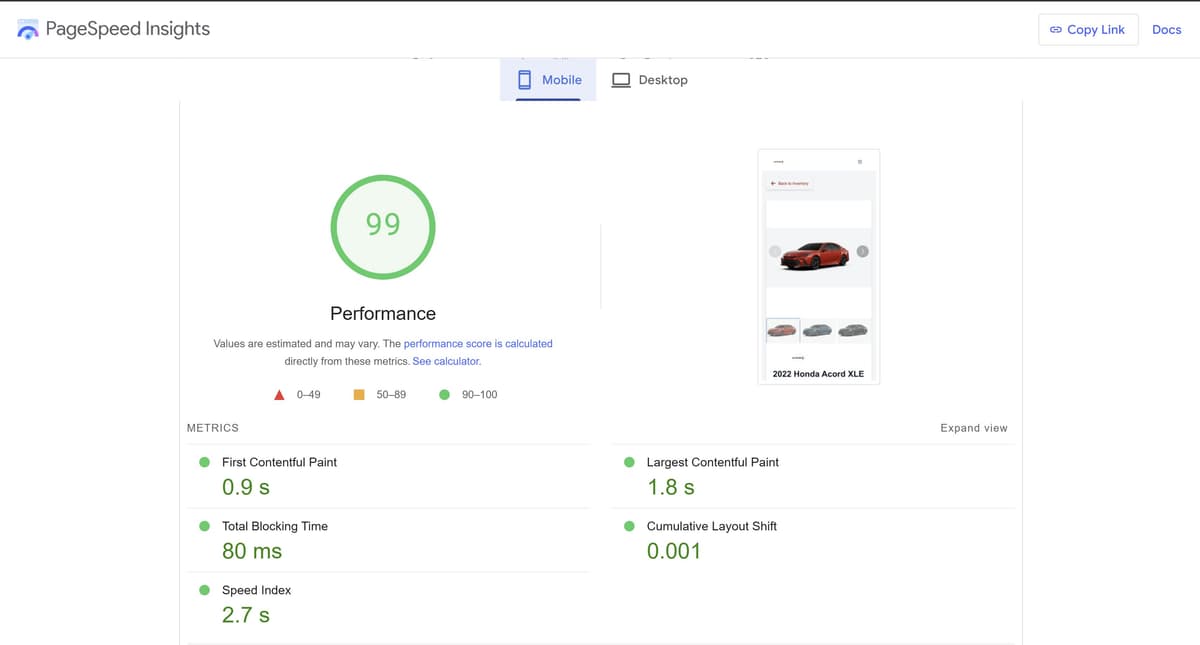
When you’re vetting platforms, don’t just trust their sales pitch. Ask for live examples of their dealer sites and test them yourself using Google's PageSpeed Insights tool. A high score tells you the platform is built for how people shop for cars today. You can dive deeper into a full list of essential automotive website features that boost both speed and sales.
Integrated Lead Capture and Management Tools
The whole point of your website is to generate leads, right? A simple "contact us" form just doesn't cut it anymore. Your site needs smart, integrated tools that make it dead simple for a shopper to take the next step.
Look for these essential lead capture forms built right in:
- Credit Applications: Let buyers securely submit their financing info directly on your site.
- Trade-in Valuation Forms: Capture leads from people looking to trade in their old car.
- "Schedule a Test Drive" Forms: Make it effortless for interested shoppers to book an appointment.
These aren't just contact forms; they’re high-intent lead magnets. They capture shoppers who are serious about buying and give your sales team the critical information they need to have a productive conversation and close the deal.
Before we move on, let's consolidate these ideas into a quick-reference checklist. This will help you keep the most important criteria top of mind as you evaluate different providers.
Critical Feature Checklist for Automotive Website Builders
Use this table to quickly assess and compare platforms based on the features that matter most for dealership growth.
| Feature Category | What to Look For | Impact on Your Dealership |
|---|---|---|
| Inventory Automation | Built-in VIN decoder, DMS integration, automatic VDP creation. | Saves dozens of hours per month; eliminates costly data entry errors and builds shopper trust. |
| SEO & Google Listings | Automatic schema markup for Google Vehicle Listings. | Taps into a massive source of free, high-intent local traffic directly from Google search. |
| Mobile Performance | Mobile-first design, automatic image optimization, fast load times. | Improves user experience and provides a professional online presence. |
| Lead Capture | Integrated credit apps, trade-in forms, test drive schedulers. | Captures serious, high-intent buyers and provides your team with actionable sales leads. |
| Customization | Full control over your domain (no subdomains), ability to add custom pages. | Builds a strong, independent brand and avoids "renting" a website you don't truly own. |
This checklist isn't exhaustive, but it covers the core functions that separate a basic online brochure from a powerful sales tool. If a platform can't deliver on these five points, it’s probably not the right partner for your dealership's growth.
A Practical Comparison of Website Builder Options
Picking the right technology partner is a high-stakes decision for any independent dealership. You need to look past the slick marketing and see how different platforms actually perform in the real world. Let’s do a straight-up comparison of the three most common routes: a specialized automotive website builder, a generic builder like Wix, and a custom Content Management System (CMS) like WordPress.
We'll frame this comparison around the things that actually move the needle for a dealership: inventory automation, SEO, mobile speed, and lead capture. By looking at each option through this lens, you'll see which one really lines up with how you operate and where you want to go.
This diagram nails the core strengths a purpose-built automotive platform should deliver.

As you can see, it’s not just about having a website. It’s about having a sales engine where inventory, SEO, and speed all work together.
Inventory Automation and VDP Creation
Your inventory is the lifeblood of your website. How fast and accurately you can get your cars online has a direct line to your sales numbers.
-
Specialized Automotive Builder: This is their home turf. These platforms are built to talk directly to your Dealer Management System (DMS). They hook up to your inventory feed and have a built-in VIN decoder. You add a car to your DMS, and minutes later it's on your website with a perfect, detailed Vehicle Detail Page (VDP). It's a true "set it and forget it" solution.
-
Generic Builder (e.g., Wix): These platforms have no idea what a car is. You have to add every single vehicle by hand, one at a time, like a blog post. It's painfully slow, easy to make mistakes, and totally unworkable if you have more than a few cars on the lot. Forget VIN decoding—you’re typing in every spec yourself.
-
Custom CMS (e.g., WordPress): Sure, you can make a custom site automate inventory. But it means paying for expensive, third-party plugins and hiring a developer who knows how to connect them to your DMS. You get total control, but it comes with a big price tag and the constant headache of technical maintenance. When a plugin breaks, that's your problem.
The Takeaway: For sheer operational sanity, a specialized builder wins hands down. It gets rid of manual data entry, making sure your online showroom is always in sync with your physical lot, without you having to lift a finger.
SEO and Google Vehicle Listings Support
If local buyers can't find you online, you don't exist. Automotive is a unique space where websites are digital showrooms that pull in huge traffic. A platform's ability to get you ranked—especially in Google's free Vehicle Listings—is a massive differentiator.
-
Specialized Automotive Builder: These platforms are engineered from the ground up for automotive SEO. They automatically create the specific "schema" code that Google needs to understand your inventory and show it in Vehicle Listings. This feature is baked right in, meaning your cars get in front of thousands of local shoppers for free, with zero extra work from you.
-
Generic Builder: Out of the box, a generic builder doesn't know vehicle schema from a hole in the ground. You could try to add the code manually, but it's a complicated, technical task you'd have to do for every single car. It’s just not a realistic option for a busy dealer.
-
Custom CMS: Just like with inventory, a custom site can be optimized for Vehicle Listings, but you'll need a developer or an SEO agency that specializes in automotive to build and maintain the schema. It’s powerful, but it requires a serious, ongoing investment in technical SEO. To learn more about this, check out our guide on the best website practices for used car sales.
Mobile Speed and Performance
Most of your customers start their car search on a smartphone. A slow mobile website isn't just an annoyance; it's a lead killer. Performance isn't a nice-to-have, it's a must-have.
-
Specialized Automotive Builder: Because these platforms do one thing, they do it well. They're highly optimized for speed, often including automatic image compression for your vehicle photos and using clean, lightweight code. The best providers build on a "mobile-first" philosophy, so your site loads fast where it counts the most.
-
Generic Builder: These platforms are jacks-of-all-trades, which often means their code is bloated to support a million features you'll never use. This can drag down performance, especially on mobile, unless you're extremely careful about the templates and plugins you choose.
-
Custom CMS: Performance is a total wild card here. It all comes down to the skill of your developer, your hosting plan, and the plugins you use. A well-built custom site can be lightning-fast, but a poorly built one can be a slow, expensive nightmare to fix. The burden of performance is entirely on you.
Lead Capture and Management Tools
A dealership website isn't an online brochure. Its job is to turn visitors into real, actionable leads.
-
Specialized Automotive Builder: These come with the lead capture tools you actually need, built right in. We're talking about integrated credit applications, trade-in value estimators, and "Schedule Test Drive" buttons placed right where they need to be on the VDPs. These tools are designed to catch serious buyers right when they're most interested.
-
Generic Builder: You're stuck with basic contact forms asking for a name, email, and message. Sure, you can bolt on third-party form tools, but they often feel clunky and disconnected from the car-buying journey. They rarely integrate smoothly into your sales process.
-
Custom CMS: You can integrate almost any tool you can dream of, from custom finance calculators to deep CRM connections. This gives you the most power and flexibility, but once again, it requires a bigger budget and the technical know-how to implement and manage everything.
For the vast majority of independent dealerships, the specialized automotive website builder hits the sweet spot. It delivers the essential, industry-specific tools you need to compete online without the operational nightmare of manual work or the sky-high costs and technical burdens of a custom build. It’s made to do one job: sell cars.
How to Pick the Right Website Platform for Your Dealership
Choosing an automotive website builder isn't about finding the one with the longest feature list. The “best” platform is the one that actually fits your business goals, your team's bandwidth, and where you plan to be in a few years. It's about finding a tool that translates techy features into real dollars and sense for your specific lot.
A platform that’s perfect for a new dealership just getting its footing could easily hold back an established operation trying to ramp up its online leads. To make the right call, you have to look past the sales pitch and match a provider’s real-world capabilities to your dealership's profile.
Match the Platform to Your Dealership’s Reality
First, be honest about where your business is today and where you want it to go. Different stages of business need different tools. Thinking this way helps you invest in a solution that works for you right now but won't need to be replaced the moment you start growing.
Here are a couple of common dealership profiles and what they should be looking for:
-
The New Dealership: Your main goal is getting online fast, looking professional, and capturing leads without a massive upfront investment or a steep learning curve. You need a platform that’s simple to launch, automates your inventory with minimal fuss, and looks sharp on a smartphone. Ease of use and affordability are your top priorities.
-
The Established Lot: You’ve already got business coming in, but you want to scale up your online lead gen and own the local search results. You should be looking for advanced SEO tools, especially for Google Vehicle Listings, powerful lead capture forms like built-in credit apps, and the flexibility to customize the site to reflect your hard-earned brand.
This kind of analysis gets you beyond a simple feature-to-feature comparison and helps you find a true partner.
The right platform doesn't just display your cars; it supports your operational workflow. It should feel like an extension of your sales team, working 24/7 to attract and qualify buyers without adding to your workload.
Knowing where you stand is the first step. The next is to ask the tough questions that will give you a clear framework for making your decision.
Your Decision-Making Framework
Before you sign on the dotted line, run every potential provider through these critical questions. Answering them honestly will reveal what you really need and help you weed out the platforms that just aren't a good fit.
-
How much time can my team realistically spend managing a website?
If you're a small, busy crew, you need a "set it and forget it" solution with as much automation as possible. But if you have someone who can dedicate a few hours a week, a platform with more hands-on customization might be the smarter choice. -
Is ranking on Google Vehicle Listings a top priority?
If your answer is yes—and for most independent lots, it absolutely should be—then you must pick a platform with built-in, automated schema markup for your inventory. Generic website builders can't do this properly, and you'll miss out on a massive source of free, high-intent traffic. Our guide on SEO for automotive dealerships dives deeper into why this is so critical. -
What’s our real budget for setup and ongoing costs?
Look past the attractive monthly fee. Are there hidden charges for setup, support, or essential tools like a VIN decoder? A platform that seems cheap at first can get expensive fast if core functions are all sold as "add-ons." -
How important is controlling our brand and owning our domain?
Using a provider’s subdomain (likeyourlot.provider.com) is okay to get started, but building a lasting brand means owning your own domain (yourlot.com). Make sure the platform lets you use your own domain and won't trap you in their system forever.
By putting each option through this filter, you stop being sold to and start actively choosing a strategic partner. This structured approach ensures the automotive website builder you select isn't just another monthly bill, but a genuine asset that helps your dealership grow.
Key Questions to Ask Before Choosing a Provider

Let's be honest, every sales pitch for an automotive website builder sounds great. They all promise more leads, lightning-fast speeds, and a design that’ll leave your competition in the dust. But to find a real technology partner, you have to dig deeper. You need to ask the tough questions that uncover a platform’s real-world performance, its hidden limits, and any surprise costs.
When you walk into a demo armed with specific, targeted questions, you shift the conversation from a generic sales pitch to your dealership's actual needs. It’s the best way to vet providers properly, sidestep common traps, and make a decision based on substance, not just slick promises.
Uncovering the Truth About Automation and SEO
Your first line of questioning should hit the two most critical functions for any dealership website: how it handles your inventory and how it shows up in search engines. Vague answers here are a massive red flag.
Get right to the point with these questions about their core tech:
- "What is the exact process and frequency for automated inventory updates?" A good answer will get specific, detailing their DMS integration methods, update schedules (like "every 15 minutes"), and how you can make manual overrides. A bad answer is a brush-off like, "Oh, we handle all that for you."
- "What are the specific requirements and steps for integrating with Google Vehicle Listings?" The provider should be able to confidently walk you through how their platform automatically generates and submits the required data feeds. If they get hesitant or start talking about manual work, their SEO game is probably weak.
- "Can your VIN decoder accurately handle unique trims, aftermarket additions, or older vehicles?" This is a great way to test the sophistication of their system beyond just pulling standard vehicle data.
This approach cuts right through the marketing fluff. It forces the provider to explain how their system actually works, not just give you a high-level overview.
A provider’s willingness to openly discuss the technical specifics of their inventory and SEO automation is a direct reflection of their platform’s quality. Evasive answers often signal a system that relies on manual workarounds.
The market for commercial website builder software is booming, with projections showing an increase from USD 2,674.9 million in 2026 to USD 4,406.6 million by 2033. This intense growth is pushing providers to innovate faster than ever. You can learn more about the trends in the website builder software market to see how this competition is shaping the tools available to you.
Vetting Performance, Onboarding, and Long-Term Support
Beyond the core features, you need to understand what it's actually like to use their platform—both for your customers and for your own team. A fast website and a supportive partner are just as crucial as a good VIN decoder.
Here are the questions that reveal the reality of working with them day-to-day:
- "Can you provide three live client websites that score above 90 on Google PageSpeed Insights for mobile?" This is non-negotiable. Don't just take their word for it; this forces them to back up any speed claims with verifiable, real-world proof.
- "Describe your onboarding process for a user with limited technical skills." You're looking for a structured plan that includes guided setup, help with data migration, and one-on-one training—not just a link to a knowledge base.
- "What are the all-in costs? Are there extra fees for premium support, advanced features, or exceeding inventory limits?" This question is designed to uncover any hidden charges that aren't advertised in the monthly price.
- "What is your process for handling technical issues or site outages, and what is your guaranteed response time?" A clear Service Level Agreement (SLA) shows they take support seriously and hold themselves accountable for their platform’s uptime.
Asking these questions turns you from a passive listener into an informed buyer. You’ll be able to compare providers on tangible performance metrics and support structures, ensuring the automotive website builder you choose is truly built to help you grow.
Answering Your Questions About Dealership Website Builders
When you're shopping for an automotive website builder, a lot of practical questions come up about cost, difficulty, and what you actually get for your money. Your website is the digital front door to your lot, so getting this decision right is a big deal. Let's tackle the most common questions we hear from independent dealers.
My goal here is to give you straight-up, clear information so you can pick a platform that actually fits how you run your business. Once you have these answers, you can move forward feeling confident in your choice.
How Much Should a Dealership Website Cost?
The price tag for a dealership website is all over the map, but you can generally break it down into three tiers. Knowing the difference helps you set a realistic budget and not get caught off guard by hidden costs.
- DIY Builders: You'll see platforms like Wix or Squarespace with plans that look cheap, maybe $16 to $50 a month. The problem is, that price doesn't include the expensive add-ons you'll need for inventory management, and it definitely doesn't account for all the hours you'll spend uploading cars by hand.
- Specialized Automotive Platforms: These are the systems built specifically for car dealers. They usually run between $50 and $300 a month. That price typically includes the essentials like automatic inventory feeds, VIN decoding, and the right SEO setup for Google Vehicle Listings. You get a lot more real-world value here.
- Custom-Built Websites: Hiring a web design agency to build a site from scratch can cost you anywhere from $5,000 to $25,000 just to get started, plus you'll have ongoing fees for maintenance. It gives you total control, but for most independent lots, it's complete overkill.
Can I Just Build My Own Dealership Website?
Technically, yes, you can. But the better question is, should you? If you go with a generic website builder, get ready to spend a huge amount of time manually adding every single vehicle, wrestling with photos, and trying to figure out automotive SEO on your own. You usually end up with an outdated, broken site that actually costs you leads.
A specialized automotive website builder is just a smarter way to go. It does all the heavy lifting for you—inventory automation, technical SEO, the works—so you can get a professional site up and running in minutes, not weeks. That means you can get back to selling cars instead of messing around with web design.
For a busy independent dealer, the best strategy isn't just to build a website. It's to launch a sales tool that works from day one with zero friction. A purpose-built platform does exactly that by automating the most painful, time-sucking tasks.
How Long Does It Really Take to Get a New Site Live?
The timeline to launch your site completely depends on the route you take. A full custom-built website can easily take several months to go from the first design mock-up to the final launch.
On the other hand, a modern platform designed for dealers can get you online almost immediately. With a system built for speed, you can often set up your site, hook up your inventory feed, and have a professional-looking online showroom live in less than an hour. That speed is a massive advantage, especially if you're just starting out or need to replace a bad website fast.
What’s the Single Most Important Feature to Look For?
While a lot of features are nice to have, automated inventory management with VIN decoding is the one thing you absolutely cannot live without. If your website doesn't automatically reflect what's actually on your lot, you're just going to frustrate customers and lose sales. It's that simple.
This one feature saves you countless hours of manual data entry, prevents costly mistakes in your vehicle listings, and makes sure your online showroom is always 100% current. Think of it as the engine that powers your entire website; without it, nothing else really works right.
Ready to launch a dealership website that works as hard as you do? AutoFire provides a powerful, easy-to-use platform designed specifically for independent dealers. Get automated inventory, built-in SEO for Google Vehicle Listings, and a blazing-fast mobile site in minutes. Start your free trial with AutoFire today and see how simple it is to drive more leads.